With deadlines looming for attractive PhD scholarships such as the Irish Research Council, current undergraduates often realise that the path to a PhD is somewhat opaque, with many different ways to get there.
There is nothing stopping you going straight into a PhD from your undergraduate degree, but it can be difficult to be competitive unless you have a flawless academic track record, or have been singled out by a supervisor as an ideal candidate and its pretty much your PhD from the start. More usually, whether you are applying for an open post that has been advertised, or your own funding through a scholarships scheme, you need to out-compete your peers. To do so requires some non-algorithmic compilation of your academic grades, degrees, and academic experiences. Opting for a taught MSc is one obvious way to lengthen your academic training on your CV, as well as hopefully improving on your track-record. Its also a useful way for you to highlight your new skills and explain how they will make you a better PhD student than the rest.
It is important to remember that simply listing your modules or new skills in bullet-points is not the way to do this. You need to elaborate, and explain how your modules improved you as an academic, and how you interacted with the course to better yourself. Don’t just say “I took a course on linear mixed effects modelling”, tell us about how you realise now that this tool is important in ecology as a hierarchical data structure is a very common feature of research in this domain, and that you can now tease apart effects that manifest within and among groups. Give an example of how you applied this tool to answer an ecological question. The MSc projects are typically larger than your undergraduate ones, and ideally you would conduct a novel enough piece of research to allow you to write it up as a research paper – this is a great way to rubber-stamp your CV for PhD applications.
Of course, MSc courses tend to cost money, and last up to one year (or some are even two years these days). Another option is to volunteer as an intern in a research group. With the right match to your supervisor, and a bit of luck, this approach can be just as good as a MSc or even better (at least in my opinion). You might intern as a research assistant helping to run experiments or collect field data for on-going projects. Such teams are often in need of extra hands, and being involved can mean you learn lots of new skills and techniques. Ideally though you want to make sure you are involved enough, and have the chance to put enough academic input to the project to deserve and be rewarded with authorship on a research paper.
Alternatively, you might intern more as an individual in a group, and work on your own project much like doing a MSc project but without the actual degree. Again, you are looking to develop new skills, learn new techniques and apply them to ecologically or evolutionarily relevant questions. The not guaranteed, and by no means necessary, icing on the cake would be a research publication.
Ultimately, some post-graduate experience will really help your CV when applying for PhDs but only if you can articulate how your efforts have improved you as an academic. A research paper (or several!) would be the ideal outcome from whatever path you take as it is nearly indisputable evidence of your ability to do science as part of a team, to a high standard and to convey your findings to an audience.
I took a research assistant position after my undergraduate degree, and used that to explain how the overall experience had convinced me of my desire to pursue academic research, as well as providing me with new skills. I am therefore quite keen on the idea of internships or research assistant positions in place of the more formal and structured MSc courses, so it’s rather a personal thing for me. Take some advice from others though, as maybe the MSc route carries more weight for different people.
On Wednesday January 14th the Pat Kenny show on Newstalk radio station hosted Professor Luke O’Neill (a prominent Trinity College Dublin Immunologist), in a segment exploring the causes of the huge declines seen in European bird populations newstalk.ie/player/podcast. Comments from both Professor O’Neill and Mr. Kenny implicating raptors and corvids in these bird declines provoked a storm on social media. Every Irish environmental NGO has strongly condemned these implications. Professor O’Neill was not in possession of the full facts and has apologised*. Predatory birds are not responsible for severe declines in many bird populations [1] and here at TCD EcoEvo we lay out the real reasons for these declines and show why natural predators like Red Kites, White-tailed Sea-eagles and Golden Eagles are in fact of huge benefit to ecosystems. Continue reading “Predators: feathered friend or foe?”
It is well known that your country of birth has a big influence on your religious outlook. That’s why Ireland is dominated by Christians whereas Iran has a mostly Muslim population. Your scientific outlook doesn’t escape from this either. For instance, it’s arguable that the idea of group selection is viewed much more favourably in the US than the UK. Turning back to religion, a group of authors have recently carried out a study on the ecology of religious belief. In their work they were able to predict the societies that believe in moralising high Gods by drawing on historical, social and ecological data.
As we’re in the beginning, we need a definition, so what exactly is a moralizing high God? These are “supernatural beings believed to have created or govern all reality, intervene in human affairs, and enforce or support human morality”. Supernatural belief has had a number of ecological correlates associated with it and this study points to environmental instability as one major driver. An environment with an unpredictable spatial or temporal distribution of resources lends itself to cultivating cooperation among the animals found within it. Among humans this results in a “reduction in cheating, increased fairness, and a tendency to cooperate”. And this is a fertile ground for the development of religious belief. One conclusion is that cultures in close proximity or those that share a common language exhibit similar religious beliefs.
However, the authors nuance this statement that this form of religion is being driven as a response to environmental harshness. In fact, they note that for societies living in a really harsh environment like the Inuits, variations tend to lead to more positive periods rather than negative ones and this seems to inversely correlate with the probability of believing in these type of gods.
One ironic point however (largely discussed in Jerry Coyne’s blog post), is that this paper is also influenced by the authors’ societal framework: a society traditionally believing in a god that they consider as moral and improving human lives. Taking that into account, some parts of the methodology heavily influence the results. The definition of morality by the authors and its benefits on humans as a species are highly depend on the societal framework where one is born. The “reduction in cheating, increased fairness, and a tendency to cooperate” is traditionally seen as a “good” thing for humanity in Abrahamic religions. Making it a universal or biological “right” behaviour is only the authors’ point of view (and probably one of their funding agencies).
Author: Adam Kane & Thomas Guillerme, @P1zPalu and @TGuillerme
This blog post from the British Ecological Society provides a good overview of the document and discussion of how it fits into existing career development opportunities for PhD students.
With ever increasing numbers of PhD graduates and restricted academic jobs, academic careers are becoming the exception rather than the rule in many STEMM disciplines. The report highlights the need for PhD students to be realistic about their career expectations and goals and the importance of continuous professional development during their studies.
The document contains guidelines and recommendations for students, supervisors, career professionals and higher education institutions. It’s very encouraging to see that the training and mentoring of ecology and evolutionary graduate students at TCD already follows many of the principles.
This is mainly due to the success of NERD club, our weekly meeting of ecology and evolution researchers. The primary purpose of this group is to develop research projects and encourage new collaborations but many sessions are also devoted to career development. We have discussed academic careers advice and application tips but also non-academic careers and the transferrable skills such as public communication and teaching that can be applied to any career choice. As students, we’re very lucky to benefit from the mentoring and advice of enthusiastic and dedicated staff members.
One aspect of the Royal Society guidelines which I hadn’t considered previously is the recommendation that PhD students should seek a mentor who is not their supervisor for career advice. It’s an interesting suggestion, especially since many supervisors have limited personal experience of non-academic careers, and a good thing to consider for any PhD student.
Hopefully these new guidelines will encourage more students, supervisors and institutions to make broad career planning an integral part of every PhD student’s experience.
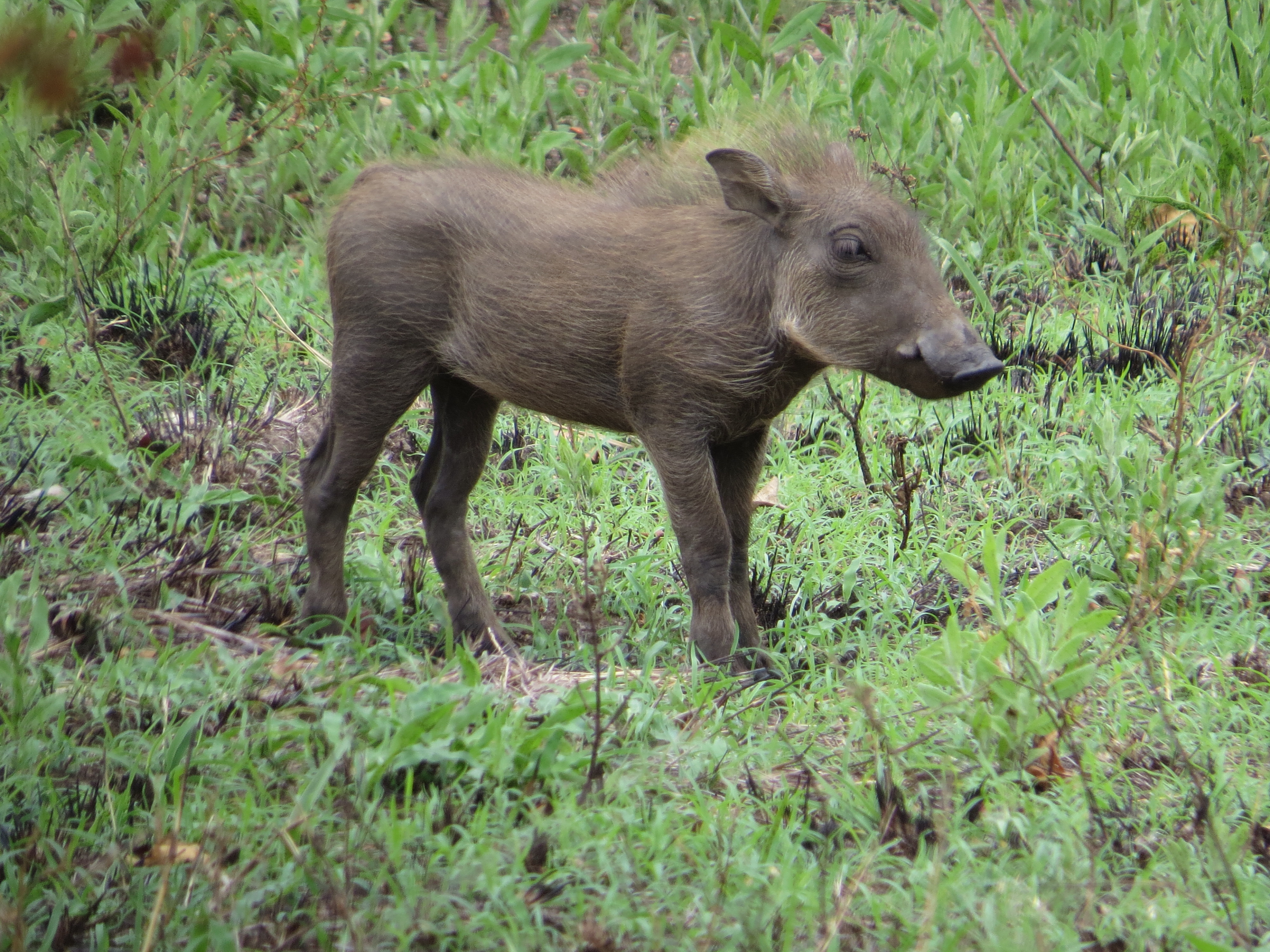
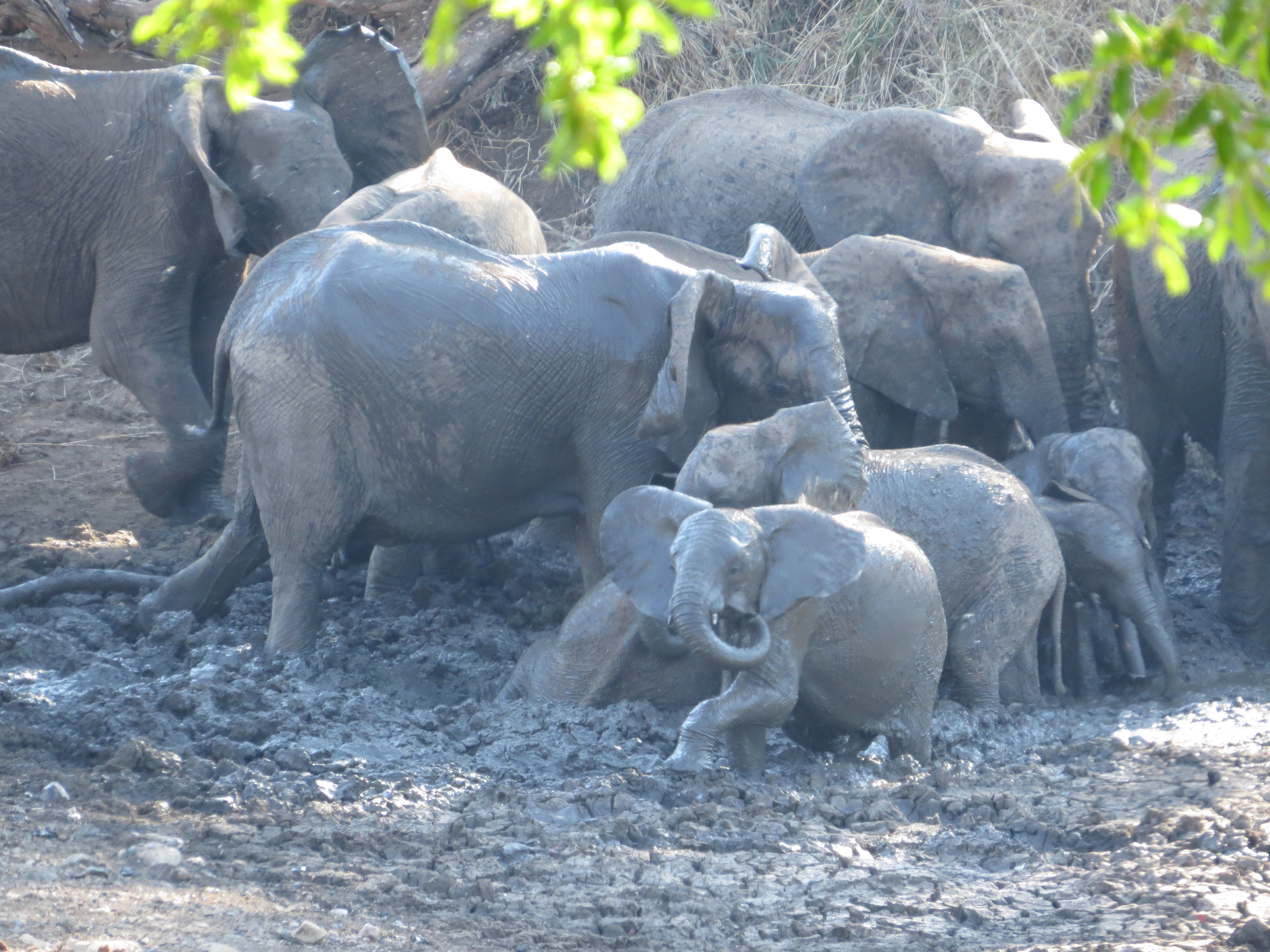
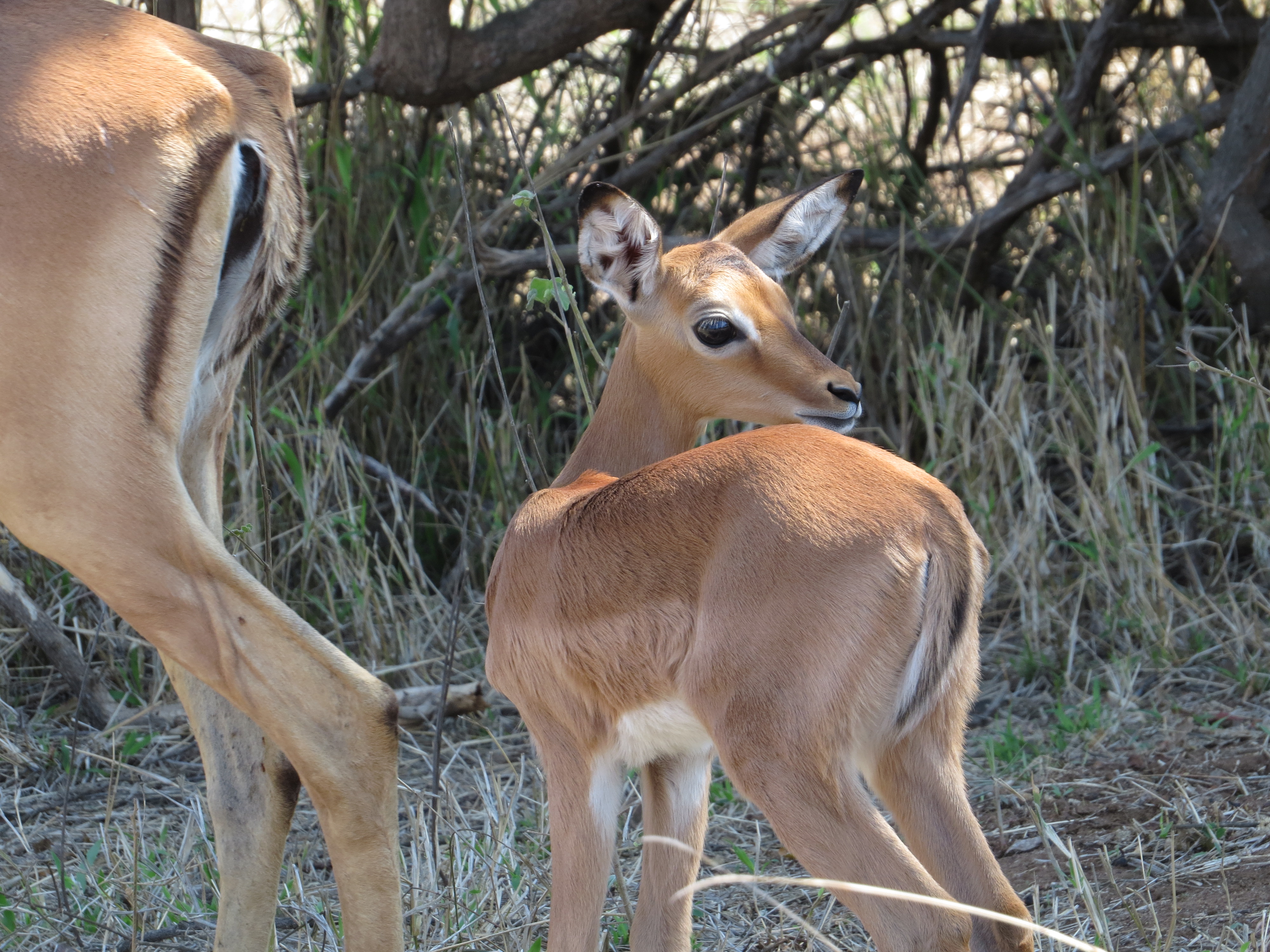
It’s easy to forget that seasons work in different ways in different places. On a recent trip to Kruger National Park in South Africa, I was expecting to see European breeding birds. I was also expecting that South Africa would be enjoying a season similar to a European spring; a simple six-month discrepancy with the northern hemisphere. While I found the European birds, including Swifts, Swallows, Cuckoos and Willow Warblers, I found a rather different type of spring. South Africa has very short transition seasons (spring/autumn) and more extended hot/cold (winter/summer) seasons. Over much of South Africa, summer (mid-October to mid-February) is a hot and sunny season, frequently accompanied by afternoon thunderstorms. In Kruger, summer is marked by the beginning of the “wet” season and the birth of new Impala, Wart Hogs and Wildebeest. However, the majority of the resident mammals don’t have a breeding “season”; all of the “Big 5” (buffalo, elephant, rhino, leopard and lion), can give birth to young in any month.
Elephant Herd Mud-bathing
The native people of the Limpopo and Mpumalanga provinces have incorporated the link between the birth of impala and the arrival of rain into folklore. Their stories say that impala are the animals that decide when it should rain. If the rain is early, the impala need it early, if the rain is late, the impala are not ready for it at the usual time. While I thought that might make the impala unpopular, it seems they are held in high esteem.
Baby Impala
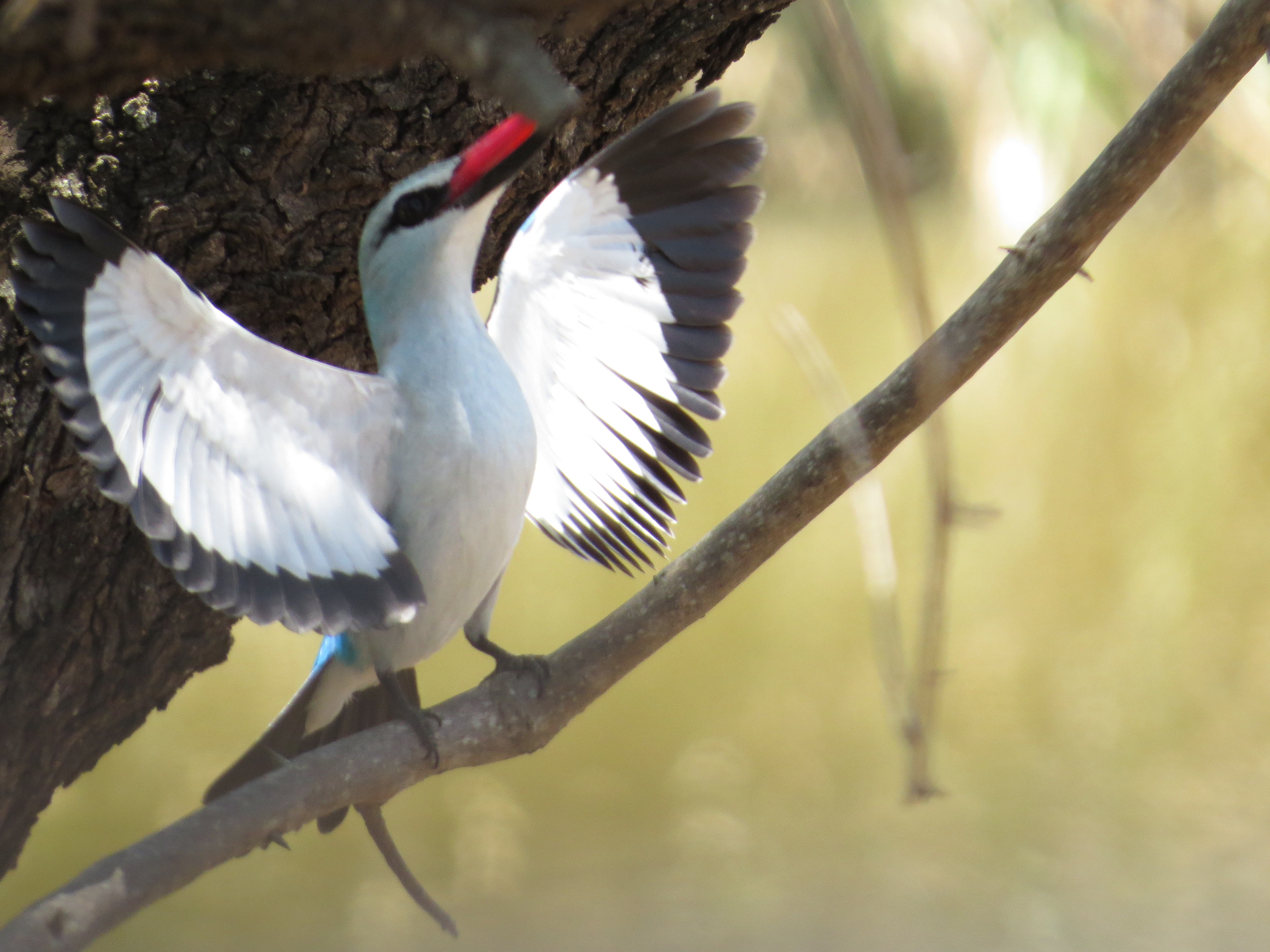
As well as the transcontinental migrant birds (like the Swallows and Cuckoos I mentioned earlier), Africa has numerous bird species which migrate within the continent. In November (the date of my visit), the Woodland Kingfishers arrive in Kruger.
Woodland Kingfisher – displaying
Their arrival is probably timed to coincide with the rise in insect numbers, following the new growth triggered by the rains, because Woodland Kingfishers feed on grasshoppers, locusts and beetles, rather than fish.
Cicada Pupal Case
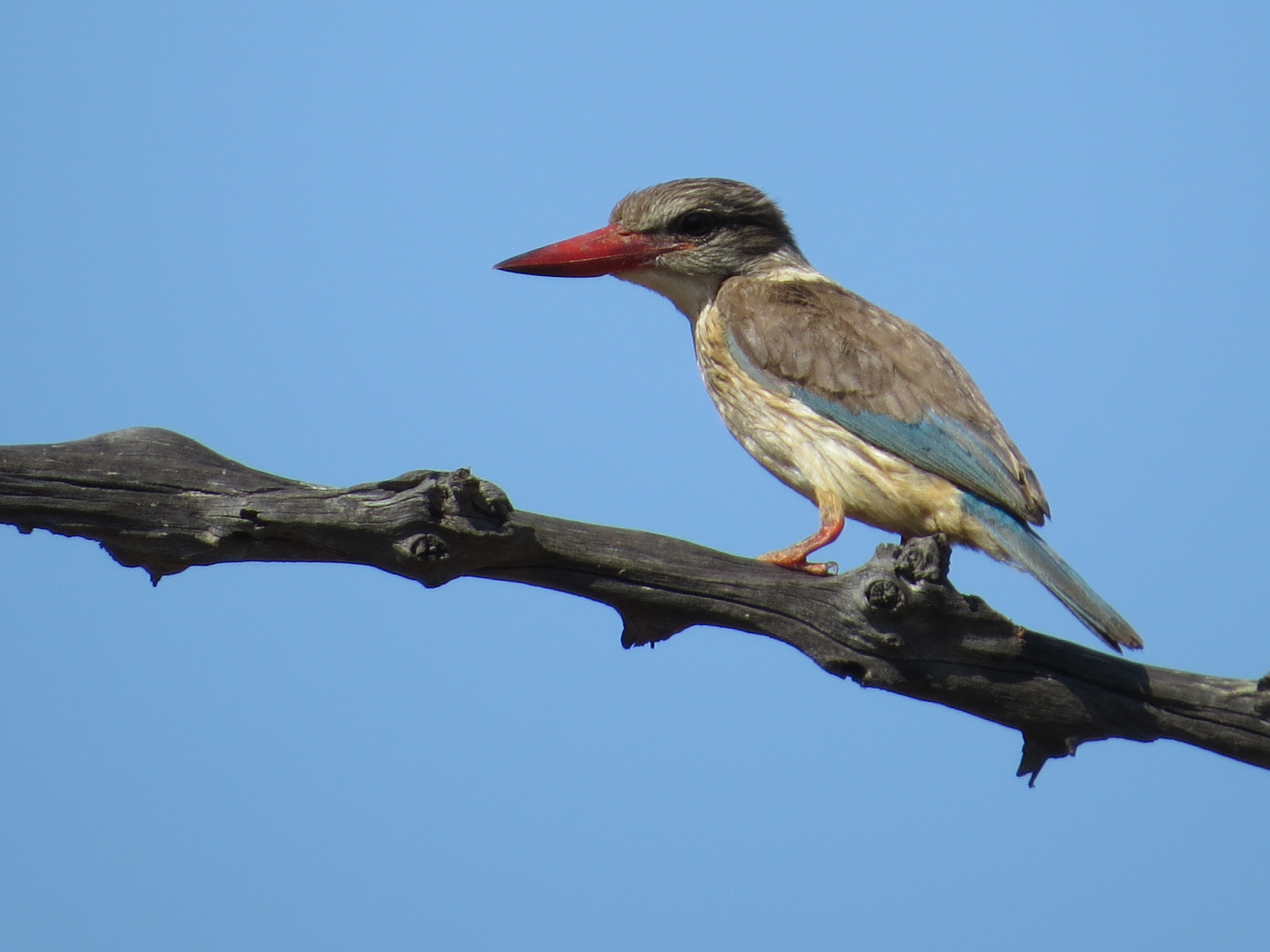
For an ecologist, migration is a fascinating area of study, especially when closely-related species compete for food at different times of year. Indeed, the migrant Woodland Kingfishers compete with resident Brown-hooded Kingfishers for food. By coincidence, a study considering such questions has just started in Kruger.
For our last post before the Christmas break we decided to collect people’s scientific Christmas wish lists from the department. We got a diversity of answers ranging from the realistic to the fantastical.
Thomas Guillerme wants a super computer “that runs everything instantly, like if you have to run a loooooooong MCMC, it spits out the results instantly.”
Natalie Cooper says “I’d like an automatic marking machine that could grade coursework and exams for me while I eat mince pies and drink tea. Failing that I’d like some friendly elves who would grade them for me while I sleep. And yes, as you may have guessed, I do have a stack on marking on my desk!”
Darren O’Connor asks for “Swarovski EL 8.5 x 42 binoculars. Their optic wizardry and quick fire focus make them unbeatable in the field.”
Aoibheann Gaughran says “what I would like is the gift of great mathematical/statistical comprehension (a little chip implant in my brain would be great!). Can I have two? Id also like the gift of speed-reading. Combined, they would mean I could quickly read all of the relevant literature, formulate a decent hypothesis to test and analyse the results with confidence.”
David Kelly is looking for “A twenty-first century view of new vertebrate species from the ICZN, to avoid the collection of voucher specimens. Even with full genome phylogenies, high-definition photography and 3D printers, the collection (i.e. deliberate killing) of type specimens remains an inescapable part of the description of new species.”
Sean Kelly is expecting big things, “An unlimited funding stream would be handy… I’d love some tiny electronic devices that can provide super accurate geographical positioning data and take high resolution video footage, as well as being able to remotely transmit all this data via satellite. I could then attach these wee devices to the beaks of birds and just wait for the mountains of data on the birds movement ecology and migration patterns, diet and feeding ecology, competitive interactions, etc, etc, to just roll in. Simples. If they’re out of stock, I’ll take a machine that sequences a bird’s full genome from a single feather.”
Kevin Healy is pragmatic, he wants “a permanent job in science that pays at least the average industrial wage”.
Adam Kane wants some new tech “I’d love an air wing of drones to spy on wildlife all from the comfort of my office.”
Deirdre McClean is looking for “an automated counter microscope that could continuously count protist and bacterial cells to make my lab life easier so I could focus on the fun parts of experiments.”
Pitch in with what you’d like to get to make your research that bit easier or more enjoyable.
Scientists and science communicators often make the point that the public are scientifically illiterate and that this needs to change. But why? The line goes that as we live in an age of science so everyone should be comfortable reading, writing and talking about science such is its pervasiveness in 21st century society. Robert Hazen argues for the importance of literacy saying, “A scientifically illiterate person is effectively cut off from an immensely enriching part of life, just as surely as a person who cannot read” (1). However scientific literacy is not something that is easily defined. So it is important to look at the various conceptions of it before asking if we can improve it.
Many authors consider science as more than a body of facts or something to be learned by rote and bemoan the dry science curricula, “It has for long been my contention that we are crushing our students into the flatness of equation-grinding automatons and forcing them into blind memorization of problem-solving procedures.” For example, there is the argument that scientifically literate individuals should possess a skill set of attributes and, for instance, be able to answer “How do we know …?” and “Why do we believe …?” questions (2). Richard Feynman said as much when he emphasised the important distinction between knowing the name of something and knowing something. There’s a world of difference between a person who can list off every bird species name and someone with an education in ornithology.
In contrast, it’s been argued that a pursuit of scientific literacy for all is futile. There are two purported stumbling blocks to widespread scientific literacy: the cumulative nature of science, resulting in an ever increasing amount of information and science’s use of counter intuitive descriptions (3). These barriers are so great as to prevent the majority of people attaining literacy. Instead we should engender an appreciation of science. The point is that a person’s early encounters with science involve fascination and curiosity, only for this to give way to courses that stress memorisation and dry subject matter.
But I think this is overly pessimistic. The important concepts in science are readily explicable to a lay person and the same goes for the process of making hypotheses. Even quantum physics, that byword for the impossible, has a legion of eager physicists who draw on a series of ingenious analogies to convey the main points behind it. I would suggest that there is a scale of scientific literacy from an appreciation of science, on to an understanding of how science works and then on to knowing the particulars of a given area i.e. a scientific vocabulary.
References
Hazen RM. Why should you be scientifically literate. ActionBioscience org. 2002.
Scientists are now being held to greater accountability by a variety of communities (both public and private), and the idea that scientists should be trusted to work in the interest of the public good, by virtue of their profession, is no longer accepted. So we now have a situation where government leaders and policy makers worldwide are finding ways to effectively communicating science and technology issues to the public and to include citizens in science and technology decision-making processes. This is a process termed upstream public engagement. Successful dialogue should prevent the given scientific issue from becoming ‘evidence-resistant’ which seems to have happened with genetically modified organisms where public fear of GMOs is a serious constraint.
It has been pointed out that when the public are left out of any such dialogue it should come as no surprise that they are distrustful of the outcomes of the resulting applications. Yet a number of arguments have been levelled against public participation in science. Bill Durodié cites four reasons that count against public participation: demoralising scientists, patronising the public, elevating new ‘experts’ and deflecting blame. However, I think his arguments are alarmist and have a number of faults which undermine his contention with public participation.
He argues that including lay opinions will result in science and scientists becoming marginalised. He says “But science is not ‘just another point of view’. It may be culturally situated, but this does not mean that it is only contextually valid.” Such a conflation of lay opinions with expert evidence would of course be disastrous but this is not what public participation is about. Upstream engagement would allow people to understand the potential risks of a science in its infancy.
According to Durodié “By having to make science more ‘accessible’ in order to be ‘inclusive’, this ends up by diluting the detail, eroding the evidence and trivialising the theory.” But simplifying science happens among scientists and science communicators all the time. Experts always have to frame their ideas to allow for ideas to be communicated to a specific target audience.
The nanotechnology seems to be taking stock of the consequences that a bad PR campaign can have. The GM debate has resulted in a ‘nanophobia-phobia’, i.e. “the phobia that there is a public phobia [,]” with respect to nanotechnology (Joly and Kaufmann 2008). The so-called emerging technologies of nanotechnology, biotechnology, information technology and cognitive science will certainly require upstream engagement with the public.
Computer scientist Bill Joy (2000) advocated a policy of relinquishment for such technologies which he deemed too dangerous. Science does not have any inbuilt mechanism to determine if research should continue; there is no moral component to the scientific method. And although I do not agree with Joy’s viewpoint, such anxiety demonstrates that certain areas of science require public upstream engagement. Indeed some commentators rightly point out that uncertain science can have an ethical and moral component and lay people are just as entitled to have their say in this respect. It is encouraging that some scientists have the prescience to recognize potential dangers of upcoming technology.
Author: Adam Kane
Photo credit: Wikimedia commons
References
Jackson, R Barbagallo, F Haste, H . (2005). Strengths of Public Dialogue on Science-related Issues. Critical Review of International Social and Political Philosophy. 8 (3), p. 349–358.
Joy, B. (2000). Why the future doesn’t need us. Available: http://www.wired.com/wired/archive/8.04/joy.html.
Film directors often call on scientific experts to lend some legitimacy to their production. A recent, notable example was that of the theoretical physicist Kip Thorne advising Christopher Nolan on the realism of the physics in Interstellar. I think directors ask for the counsel of scientists in cases where they seek to make a film with at least one foot in reality rather than an outright fantasy. In Jurassic Park, a more biologically relevant movie, director Stephen Spielberg had noted-palaeontologist Jack Horner instruct the production team of the latest findings in dinosaur biology. The book and film of Jurassic Park had a significant effect on the public perception of dinosaurs coming as they did in the wake of the dinosaur renaissance of the 80s where the animals were reappraised as fleet footed, intelligent creatures. This was a radical departure from the image of tail dragging sluggards common in the early part of the 20th century (see King Kong). For instance, Horner was quick to quash the idea of a snake-like forked tongue for the Velociraptors. This was a great example of science and art working together in symbiosis. The film was a box office success and the public consciousness was updated to have in mind a more accurate image of what dinosaurs were really like. Of course the film wasn’t perfect in its representations and nitpickers had plenty of grist for their pedantic mills, but overall both ‘sides’ were happy.
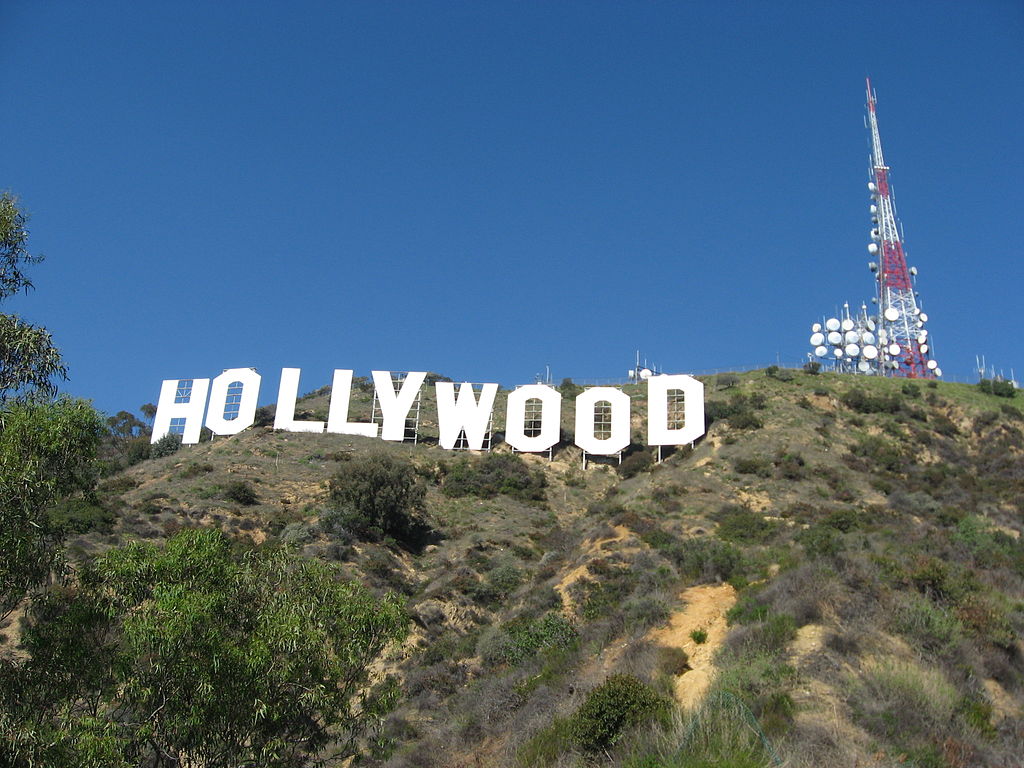
But now the release of the trailer for the 4th film in the series, Jurassic World, has caused consternation among palaeontologists. It’s clear from the footage that the dinosaurs haven’t evolved along with the science as they did with the first film. Mainly, that means no feathered animals; perhaps the studio executives weren’t convinced that a fluffy Tyrannosaurus could induce as much panic in an audience. Capturing the disappointment in the scientific community, John Conway writes, “Of course we realise it’s a film – but we also recognise the power it will have to shape people’s ideas about prehistoric animals. And in Jurassic World’s case, it looks like we’re getting a very dull monsters trope. ” This leads to the question as to what does Hollywood owe science? It’s a hard one to answer because there’s no moral imperative for a director to follow the strictures of scientific fact exactly. James Erwin says “The truth is that science fiction is, first and foremost, fiction—and that’s how it should be judged.” I agree with this to an extent, in that if a director is striving to give a message and has to break away from scientific reality to achieve this than so be it. Think of something like the ability of characters to invade dreams in Nolan’s Inception. Nevertheless in the case of Jurassic World I’d bet we’re going to get yet another discussion of man’s hubris , a trope that has been reiterated throughout the Jurassic Park series. If they were able to do this while creating the most realistic dinosaurs at the time in 1993 I don’t see why they couldn’t continue to do so in 2015. Maybe it just rankles with me that we’re seeing another edition in a series of diminishing returns and I should check my hopes. I wonder what other people think of this? But it’s still frustrating for me. Lost World? More like Lost Opportunity.
Quite regularly you get emails that annoy you… often they are flippant emails, and sometimes from students. Harmless or probably naïve that they are, they do get up some peoples’ noses.
But every once in a while you get one that really gets your goat. Several months after some media coverage of a research paper from my group (as it happens one of my favourite papers I’ve been involved with of all time) I got a real gem of an email.
“Woah!!! Who the F*%K is this guy and why is a CEO of an internet security company sticking his nose into what at this stage is an old press release for a research paper?” was my first impression. This guy just doesn’t get it was what I settled on in the end… but here is what played out.
Turns out Luke Latham has published 4 research papers with a modelling angle. He seems to have a bee in his bonnet though. He also has a knack for writing a totally rude and irritating email that only incited me to reply mirroring his rudeness – a subtlety of irony apparently lost on him. I have posted all the emails, along with some pointers as to how he managed to stuff up a perfectly reasonable email in the first instance. In the end I ignored this for my own sanity, and only now got around to writing up this blog post without getting too annoyed. My advice on how not to write like a [insert derogatory word of your choice] is in italics.
The icing on the cake was that he wrote to one of my colleagues (not my line manager) and told them they shouldn’t give me tenure because I was rude! I just don’t think this guy does social interactions very well. Needless to say he was told that it was totally inappropriate for him to try to influence decisions like that, and in any case, the Irish system is not like the USA one, and as it happens, I am tenured!
Subject: Major FAIL on one of your press releases [oh man.. before he has even begun this has annoyed me. “Major FAIL” is confrontational to say the least… I’m really hacked off already.]
Hello, [uh oh… the bad start continues… Dear Sirs/Madams/Prof/Andrew would have been better. This doesn’t bode well… ‘who is this dude’ I’m thinking]
“Scientists have discovered proof that the evolution of intelligence and larger brain sizes can be driven by cooperation and teamwork, shedding new light on the origins of what it means to be human. ”
There is no such thing as “proof” in empirical science based on statistical models. Whomever wrote that summary of the research in your office is a scientific ignoramus. Scientists are not in the business of “proving” things. It is true that with an overwhelming amount of statistical and observational data, we lift a hypothesis to the level of calling it a “theory” and give it a special place as a scientific principle, but no single study can ever provide enough information to make a theory … and even theories are falsifiable in principle.
[Entirely correct about falsifiability of hypotheses.. but I stand by this statement…. “intelligence… can be driven by cooperation…” is the key finding… with emphasis on “can”. People have speculated for ages that it should drive it, and we showed, I think for the first time, that it can. Whether other selection pressures exist in place or tandem with this is beyond the scope of our paper. We did not say we proved that intelligence in humans was driven by cooperation, but that it could be. I see nothing at all wrong with this statement, no matter how pedantic one wants to get]
Next, you’re way, way off base claiming that this sheds new light on “what it means to be human.” The researchers’ 50 brain computer models that were run through a series of computer games (also vastly simplified over real-life interactions) were so simplistic and unlike real brains that its virtually impossible to draw any conclusions about such a correlation in real organisms. There is nothing wrong with computer simulation per se, as they can be quite helpful in research, but let’s put simulations in context: Simulations can point you in the direction of possible real-life biological relationships but never be used to draw firm conclusions about biological organisms. Simulations are just too vastly oversimplified to guarantee that the phenomenon under study will yield the same results when experiments are carried out on real organisms. Only empirical research on organisms themselves can be used to draw conclusions about organisms.
[I disagree, but I’m not getting into this here. This is a perfectly reasonable question, and one I would have been more than happy to engage with had Luke Latham, CEO not been such a jerk]
Educators (at least here in the US) have utterly failed to teach people what science is and how science works, and you jumped right on the bandwagon spreading misinformation. I think you should release a retraction on those statements in a new press release. In the future, I hope you will run your press releases that deal with scientific subjects past a REAL scientist before publication.
[I’m rather proud about how I, and my group communicate science to the discipline and to the wider public. We have a good track record of public engagement. This is just insulting, but again, I don’t think he gets it. He has also implied that we have “utterly failed” which is just inflammatory. And worst of all…. I was the “REAL scientist” that helped to write and ultimately signed off on that press release… so “[insert expletive of your choice here] you Luke Latham, CEO”]
Luke Latham, CEO
GuardRex Corporation
Cheyenne, Wyoming, USA
———————————————————————————-
So… in spite of my better judgement, I replied… and hastily… (though I don’t regret anything)
———————————————————————————-
Date: Mon, 8 Sep 2014 16:09:24 +0100
Subject: Re: Major FAIL on one of your press releases
hello to you too [this was me being ironic and parodying his own choice of impersonal address… he didn’t get this… but maybe one can start to build up a picture about how this guy thinks and deals with people]
yeah, thanks for this. I feel enlightened. [ok… so straight up sarcasm]
maybe next time you could proof all our press releases? You seem to have a special grasp [of] things. [parodying his “In the future, I hope you will run your press releases that deal with scientific subjects past a REAL scientist before publication.”]
I think you should read things a bit more carefully and put some thought and maybe even a hint of decency and politeness into your missives. [this is me parodying his “I think you should release a retraction” bit, but again he seemed to miss this irony]
In the future, I hope you will stick to whatever it is you might be good at. [and a return to his “in the future I hope you will….”]
Andrew
———————————————————————————-
He replied. But also apparently wrote to a colleague behind my back in a vain (both narcissistic and pointless) attempt to have my tenure blocked… nice guy eh?
———————————————————————————-
Subject: Major FAIL on one of your press releases
Dr. Jackson,
My comments have nothing to do with the quality of your research or institution. I happen to be a great supporter of computer simulations of biological phenomenon (see http://www.bioone.org/doi/abs/10.1662/0002-7685%282008%2970%5B30%3ACARSFT%5D2.0.CO%3B2 ). My comments were directed to your Communications Office regarding their comments about your research … their inappropriate statements regarding “scientific proof” and the extrapolation of the results to “what it means to be human,” which you well know are inappropriate.
[well Luke… had you taken some time and being vaguely more polite you would have discovered that I wrote that press release with my co-authors, and signed off on it too. So actually your comments do have relevance to me and my research. Also… by your logic, you were not being a rude ass to me, but to my communications office? It’s not ok to write emails like this to anyone, and as it turns out, your ire was directed at me]
If your study drew conclusions on differences in simulated brains with a statistical model, then I doubt that your P-value was 0 (zero)! I don’t understand your hostility to my remarks. You should be just as upset as I am that non-technical, non-scientists constantly speak about scientists “proving” things, when that is utterly impossible and not really the point of advancing our knowledge of biological phenomena.
[he doesn’t get it. I seriously wonder about this guy’s social skills]
“Read things a bit more carefully”? What do you mean? … that was a direct quote from your institution’s press release. It is abhorrent to the process of science and to the education of a public that is scientifically illiterate (here in the US … I know things are much better in your country, where education is taken more seriously). As for “stick to whatever it is you might be good at,” I really don’t think that’s a fair remark given that you really didn’t explain how my original argument is false. In regard to “decency and politeness,” I don’t understand that attack either: I don’t make a single statement that can be taken as a personal attack on anyone. I’m talking about scientific incompetence … I’m sure the fellow or lady who wrote that press release is a perfectly nice person. My differences with the press release are professional … and respectful insofar as one can be when I see a daily misrepresentation of the process of science (here in the US, again, I know these matters are handled better in the UK).
[nope. Doesn’t get it. Also Luke… Ireland is not in the UK, we are a sovereign independent country. It really is difficult to endear oneself to this guy.]
I’m sorry that you are offended by my concerns, but we’re losing the battle over here in the US. The press release was taken out of context by a popular blog writer here and used to inappropriately support his arguments about cooperation in business organizations. We really don’t need scientific results misused in this way. I’m just attempting to call attention to a serious general problem in the dissemination of scientific information. If you don’t want to take the matter up with your Communications Office, if you feel their statements were perfectly acceptable, then just forget the matter. But if you do, then don’t cringe the next time someone says that evolution is “only a theory” or that climate change is not a heavily man-made/man-caused problem.
[I think I finally see where he is coming from. He has a bee in his bonnet about how science is treated by some corners of the media. You can’t get bent out of shape with the free press for how they report on findings. Some will be better than others, and some will mis-quote. But having a free press is better than trying to impose control over them. We could have had a civil discussion, but Luke Latham, CEO stuffed it up from the very first subject line. Sorry Luke, im not going to engage with you.]
Luke
———————————————————————————-
There you go. This whole thing really annoyed me and had me seething for days. Nice to be able to right this up now without feeling my blood boiling though.
 With deadlines looming for attractive PhD scholarships such as the Irish Research Council, current undergraduates often realise that the path to a PhD is somewhat opaque, with many different ways to get there.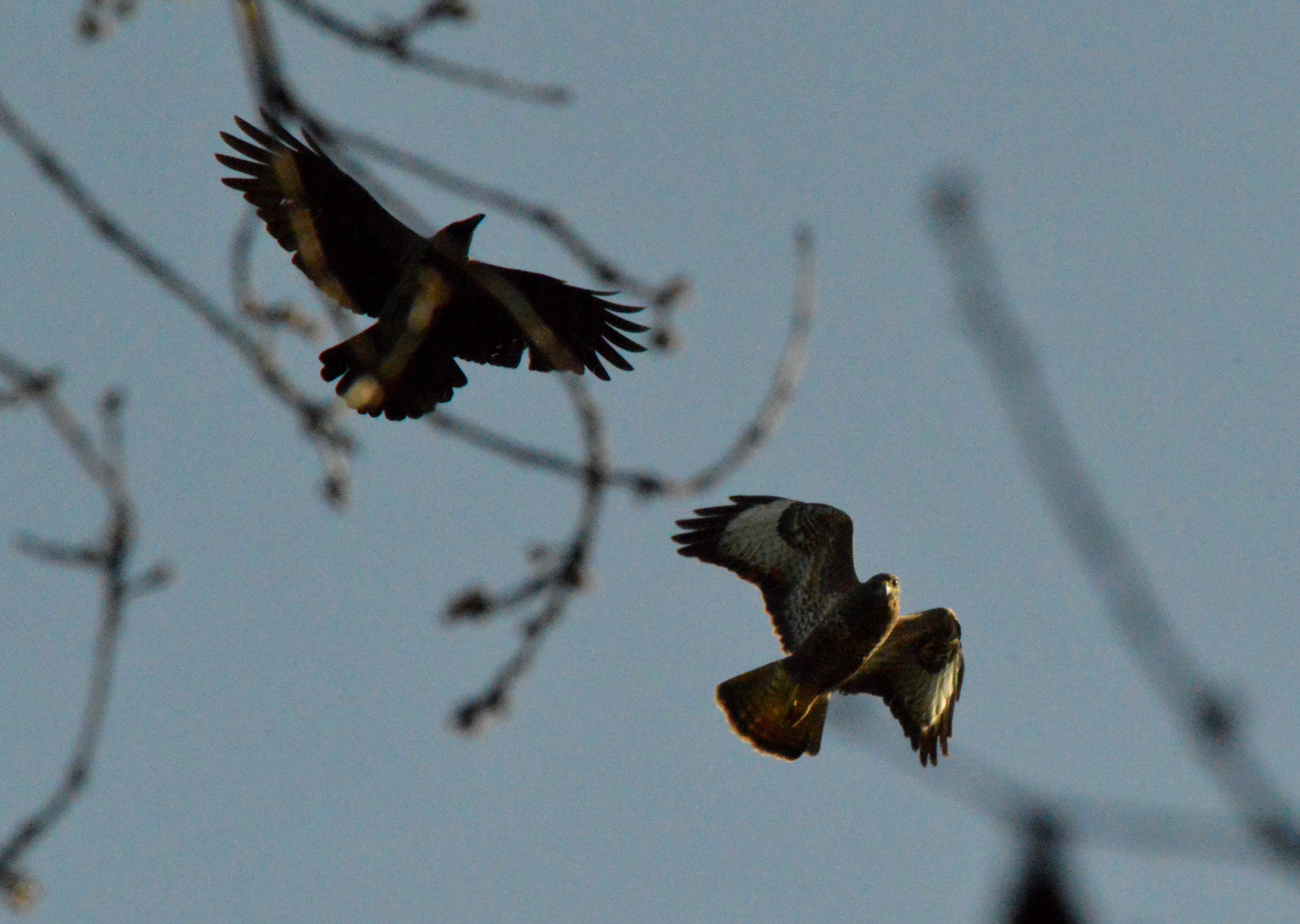


 Scientists and science communicators often make the point that the public are scientifically illiterate and that this needs to change. But why? The line goes that as we live in an age of science so everyone should be comfortable reading, writing and talking about science such is its pervasiveness in 21st century society. Robert Hazen argues for the importance of literacy saying, “A scientifically illiterate person is effectively cut off from an immensely enriching part of life, just as surely as a person who cannot read” (1). However scientific literacy is not something that is easily defined. So it is important to look at the various conceptions of it before asking if we can improve it.