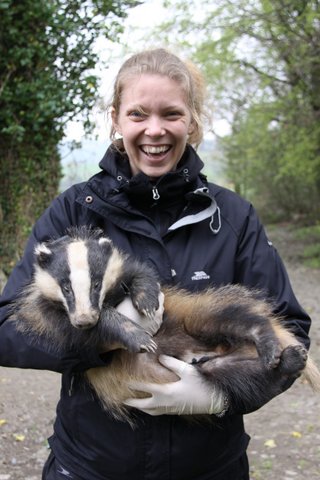
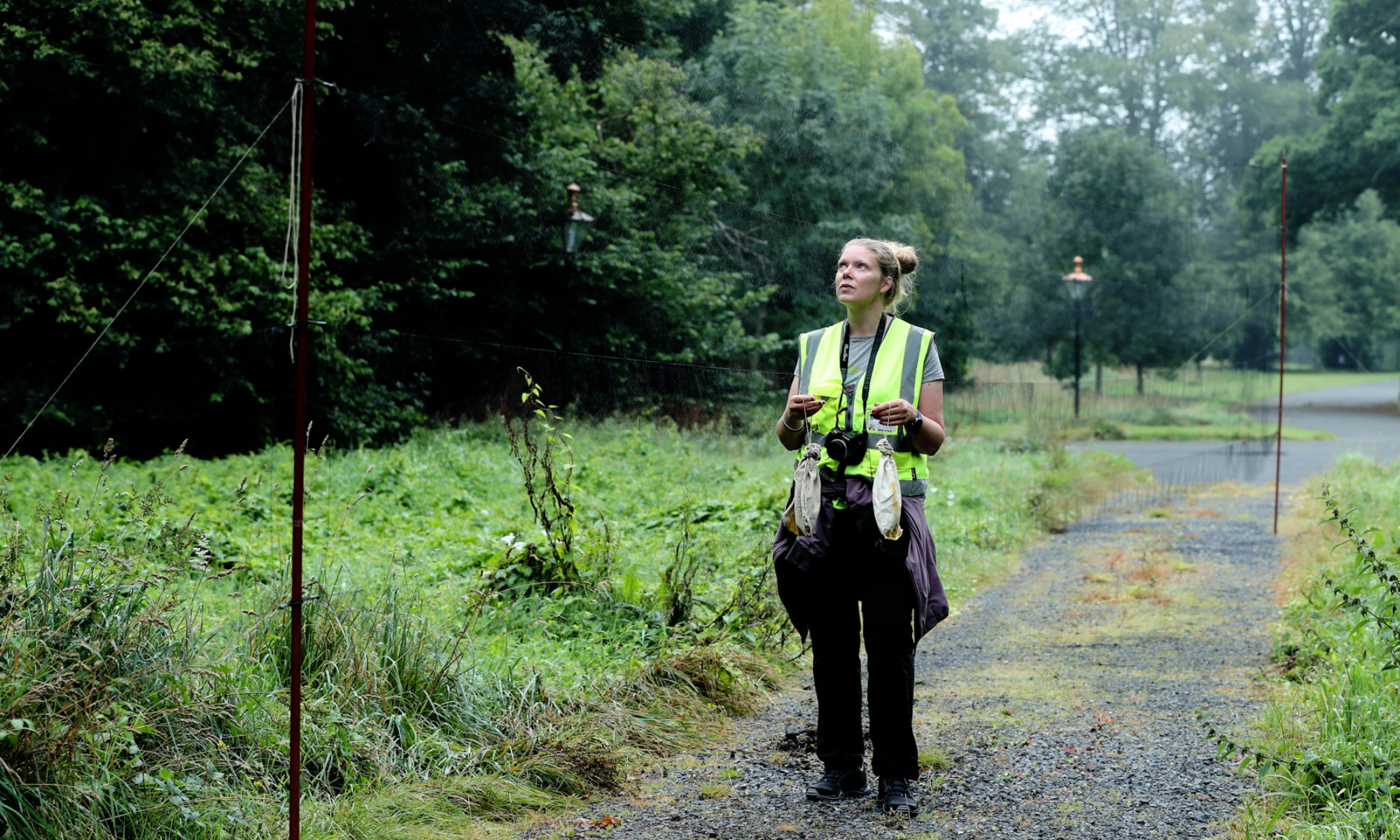
One of the best things about my PhD has got to be the fieldwork. My project involves analysing the GPS data of a population of badgers to find out where they forage, how big their territories are, who lives with whom and how they disperse. This means putting GPS collars on them twice a year. Badgers have a bit of a bad rep, one they really don’t deserve. Contrary to popular opinion they are not vicious beasts that, once clamped on to your foot, won’t let go until they hear the bones crack (people say this to me a lot). They are in fact quite timid and very cute with it! Continue reading “Badgery Fieldwork”
Ostrich Knees
Dear Dr. Jeal,
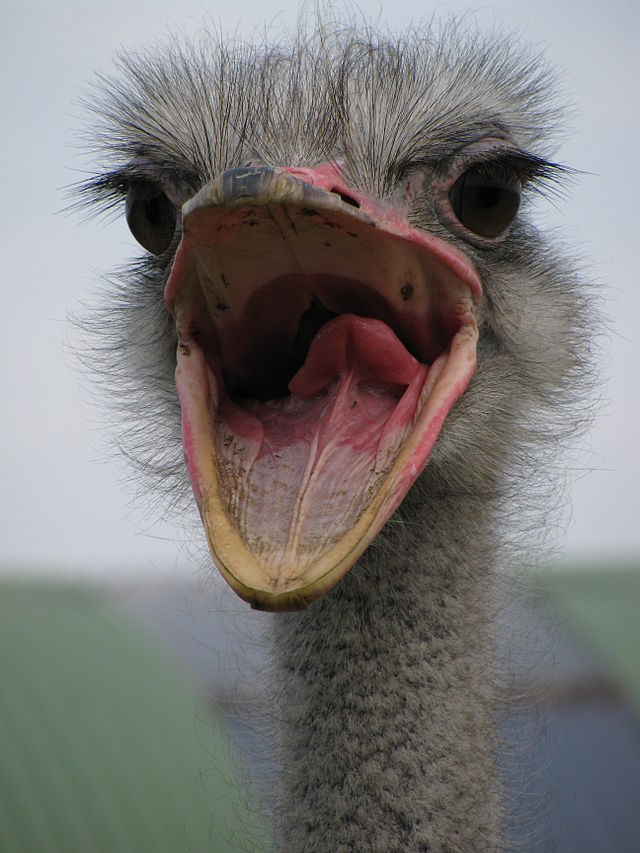
Why is it that when a mammal kneels down its legs bend forwards, but when an ostrich bends down its legs bend back?
– Junior Sophs.
The question you ask is quite curious, but I don’t think you’re on the right track,
Saying “knees of a mammal bend forward, while knees of an ostrich bend back.”
But I quite see the cause of your problem, and it’s really quite simple you see,
As the bend in the leg of an ostrich is more like an ankle than knee,
The true knee of an ostrich bends forwards, and it’s quite a remarkable thing,
It’s up at the side of the body, tucked closely under the wing.
The leg is quite similar in all birds, but ostrich proportions are wrong,
As the femur is very foreshortened, while the foot is extraordinarily long.
As the leg is made largely of foot-bones, you’ll ask “What are its feet” I suppose,
I’ve an answer all ready for that one. What you think are its feet are its toes!
Author
Frank Jeal
Photo credit
wikimedia commons
The importance of being Earnest – The case of climate change
In Oscar Wilde’s comedy “The Importance of Being Earnest”, Cecily and Gwendolen want to marry a man named Ernest simply because of the name’s connotations. They are so fixated on the name that they would not consider marrying a man who was not named Ernest. The name, sounding like “earnest”, shows uprightness, inspires “absolute confidence”, implies that its bearer truly is honest and responsible.
A name can truly be very important when it embodies the communication of a message. Surprisingly (or not) it is also important when dealing with international treaties and initiatives. An example is the story of the Ozone Hole and the Montreal Protocol, the most successful governmental agreement on an environmental problem at the global scale. The Montreal Protocol, signed in 1987 by 46 countries (now having nearly 200 signatories), banned the use and production of chlorofluorocarbons (CFCs) worldwide, recognizing that they represented a threat for the stratospheric ozone layer. During the celebrations for the 25th anniversary of the Protocol, Jonathan Shanklin, Head of Meteorology and Ozone Monitoring Unit for the British Antarctic Survey declared that in retrospect, the Ozone Hole was a really good thing to call the ozone depletion problem “because an Ozone Hole must be bad. Almost automatically, it meant that people wanted something doing about it. The hole had to be filled in”.
Much more confusion is involved in naming another problem at the same global scale: global warming, or climate change. The international agreement on it, the Kyoto Protocol, is not being as successful as the Montreal one.
“Global warming” and “Climate change” are two different phenomena, casually related. “Global warming” refers to the observation of a long-term trend of increasing temperatures. “Climate change” refers to different changes in climate phenomena driven by the increasing concentration of greenhouse-gases in the atmosphere. The alternative use of the two “names” probably contributed to the misunderstanding of the problem for the general public, giving alibis to those who are (conveniently) sceptical about climate change. That happens for example whenever a winter is colder than the year before, or more snowy, then “where is the global warming?”.
Surely the fact that the Montreal Protocol was successful and Kyoto Protocol is not, has much more profound and complex reasons than just the “naming”. There is however a trade-off between scientific rigour and effective communication to deal with. Scientific rigour should guide our management plans, effective communication should stimulate actions.
The scientific community and political stakeholders have to be “earnest” in balancing rigour and communication strength.
Author
Luca Coscieme, coscieml[at]tcd.ie
Trip to the tropics: rising water in the Rift Valley lakes
We drive out of the compound just after dawn; a convoy of four vans full of final year science students and staff. We heard lions calling beyond the fence last night, and we haven’t gone 500 meters before we see them: two males strolling off to the left. Within hours, we will have seen herds of buffalo, jackal, giraffe, vervet monkey, baboon and, most impressively, both black and white rhino, among many other birds, reptiles and mammals. The tourist in me is delighted to see so much so quickly, but there is a good reason why the animals are so close to the tracks. This is Lake Nakuru National Park in Kenya, and Lake Nakuru is rising, forcing the animals living there into a narrowing strip between the water and the boundary of the park.
The water levels in the Eastern Rift Valley lakes have a history of fluctuating wildly. From a peak in 1961, they have fallen and risen in response to drought and heavy rainfall for the last 50 odd years. Current lake levels are the highest they have been since the 60’s, but now, something very interesting is going on. Weather conditions have not changed to the degree that would predict such an extreme rise in the lake water, and people are searching for other explanations.
Some commentators believe that the changes are driven by human impacts. They claim that activities such as tree felling, house building, cultivation and increased grazing pressure have caused more water to run off the land into the rivers which feed the lakes. Because of the very seasonal rainfall, flash floods are common and they carry large sediment loads into the lakes. This sedimentation has also been blamed for the rise of the lakes, which is a bit confusing as sedimentation was previously blamed for falling water levels. Tectonic activity has been suggested as a possible explanation: local compression of the African plate governs opening and closing of fractures through which water can seep. A change in the pattern or amount of local rock fracturing could affect water levels.
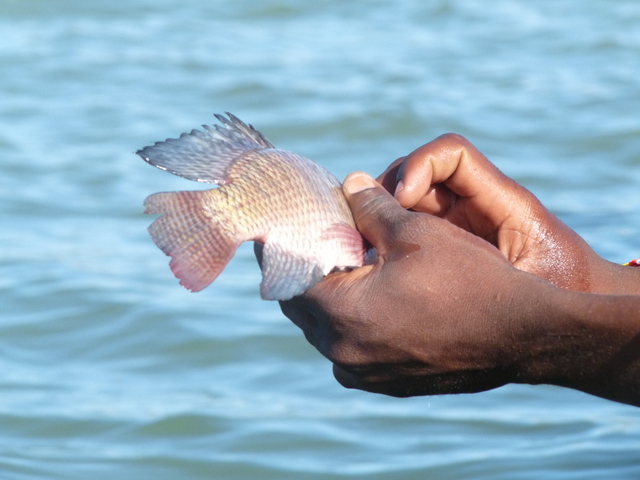
While the debate over the cause of the changes continues, there are obvious social and environmental implications. At Nakuru, the land area of the park has decreased and animals are more concentrated along the margins of the park. The problem of over grazing has intensified, animals are easier to find for tourists but also for poachers, and the potential for human-wildlife conflict has increased. The lakeshore hotel at Baringo now stands under several feet of water, no longer providing jobs or bringing valuable revenue into the area from tourists. At Lake Bogoria, the lake water has become fresher as it has risen. This has inhibited the growth of the cyanobacteria upon which the lake’s iconic lesser flamingo flocks depend so flamingo numbers have fallen. But it is an ill wind that blows no-one good – rising water levels are a boon for fishermen.
Looking back over the 20th century, fluctuating water levels appear to be the norm in the Eastern Rift Valley, but they are very difficult to foresee. Knowing how frequently, how far and how fast the lakes rise and recede would be a huge benefit to local people. It is a complex problem, and one which would require a wide range of expertise and a lot of money to solve. In the meantime, the lakes are mercurial, providing and destroying land and livelihoods.
Author
Aoife Delaney
Photo credit
Aoife Delaney
Stress Busting
Inspired by recent reports of rising mental health problems in academia plus an acute increase in stress around the department this summer when many PhD students were writing up, we decided to run a “Dealing with stress” seminar at NERD club (ironically this session was canceled previously due to the PIs being “too stressed” to run it!). It turned out to be a really positive experience, and I’d definitely run something similar again. Here is what we found out!
What is stress and why is it bad?
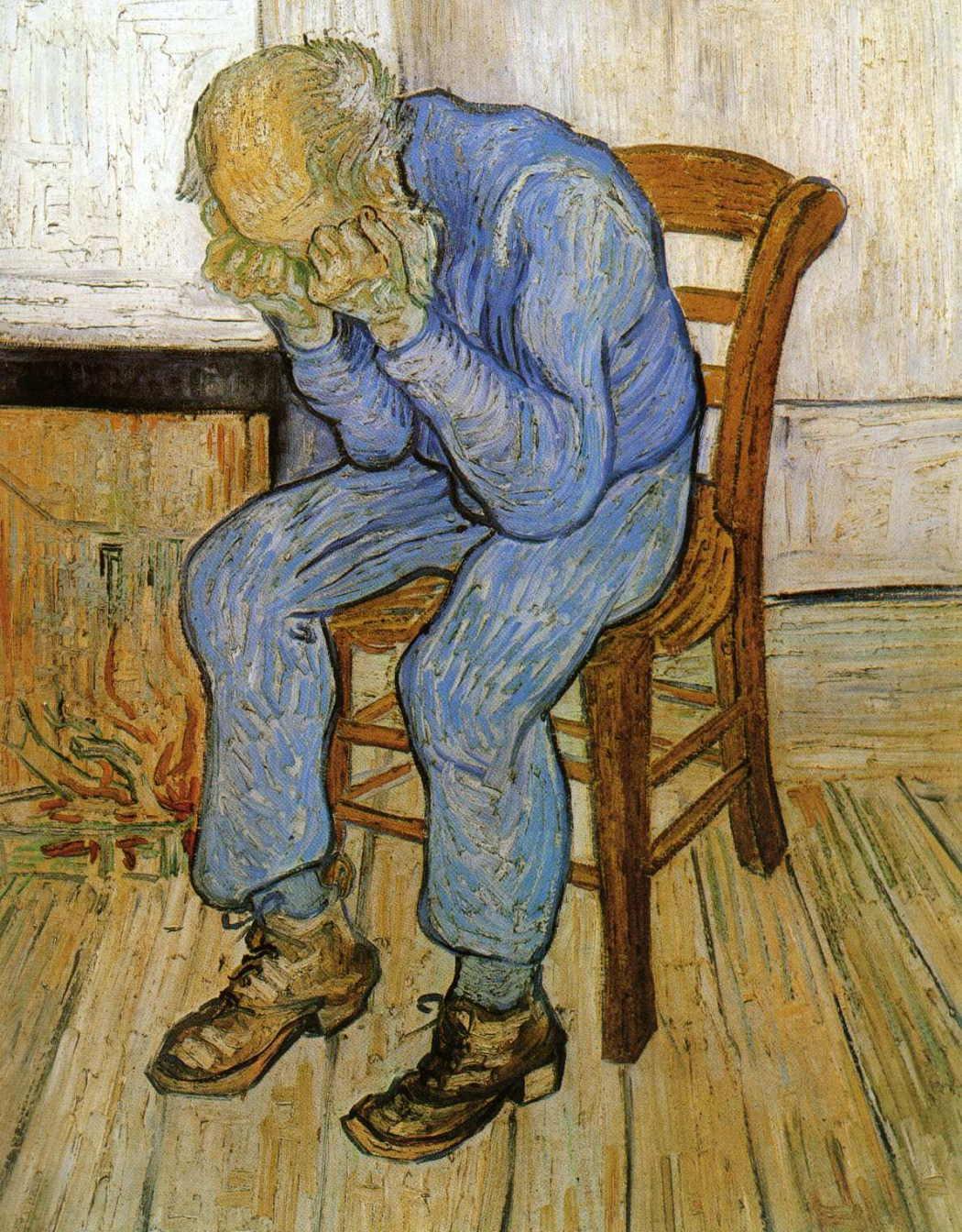
Stress is an “adverse reaction to excessive pressure”. Short term stress responses can actually be beneficial, either for escaping angry bears or finding that last bit of energy needed to finish a manuscript, thesis or endless admin task. However, longterm chronic stress is really bad for you. Symptoms include headaches, nausea, digestive problems, ulcers, lowered immune responses, changes in appetite, altered sleep patterns, mood swings, lowered self esteem, negative thinking and more. All of these can trigger chronic mental health issues like depression and anxiety.
What causes stress?
Causes of stress are really varied; what stresses one person out has no effect on someone else. Some articles put causes of workplace stress into six categories: (1) too many demands; (2) too little control; (3) poor relationships with coworkers/superiors; (4) too much change; (5) too little support and (6) lack of clarity about your role. Unfortunately, as one PI pointed out, these six things define academic jobs!
We started our stress seminar by independently writing down everything that made us stressed/worried on Post-It notes and then placing these into a bin at the centre of the room (this was for convenience but I guess you could say we were symbolically throwing our troubles away…). We then shared these with the group. Unsurprisingly we’re stressed about similar things. I expect you’ll recognise some of the following:
Lack of structure/direction, pressure to come up with new ideas, balancing fun stuff with work stuff, the two body problem, struggling students, R, GIS, statistics, field work, risk assessments, paywalls, graphs, “the literature”, bad paper reviews/rejections, losing data due to a bug, forgetting deadlines, worry about not finishing PhD on time, feeling out of control, lack of public understanding of science, admin, pressure to produce outputs more regardless of quality, letting people down in and out of work, dealing with conflict/difficult meetings, saying yes too much, grant writing/rejections, public speaking, and, my personal favourite, how much coffee is too much???
We also had several things that everyone was stressed about. These were deadlines (aka having too much too much to do and too little time to do it), career uncertainty (sadly not something we can solve), and a lot of worries that fall under the category of impostor syndrome. The latter included worries about finding errors in data/analyses after submitting/publishing papers, worries about saying stupid things in front of people, feelings of inadequacy in relation to others and to your own potential, fear of failure etc. Generally the terror of being “found out” for being too stupid to do research. I think most of us found it quite reassuring to share these fears, including the PIs!
How can we reduce stress?
There are lots of suggestions online for reducing stress (including dowsing your house for geopathic stress – hmmm yeah…), here are just a few we discussed:
1) Talk about it.
Talk with family, friends, workmates or anyone really. If you’re having problems at work it’s a good idea to talk to your supervisor or line manager, or another staff member if your supervisor is the problem! Many of us also flagged how useful it is to speak to a professional counselor when problems get too big for you to handle alone (most universities offer free services to staff and students). An important point was that you shouldn’t be embarrassed – everyone feels stressed sometimes and it is not a sign of weakness.
2) Look after yourself.
Get plenty of sleep and exercise, don’t drink too much caffeine or alcohol, and try to eat a well-balanced diet (apparently chicken dippers are fine because BBQ sauce counts as a vegetable).
3) Learn to notice when you’re stressed and do something about it. If you don’t realise you’re stressed it’s hard to solve the problem, so learn the warning signs and symptoms and act accordingly when you notice them. It may help to keep a stress diary to work out what triggers your stress, and then avoid those situations and/or people!
4) Increase your productivity.
Many of the issues of having too much to do, or worrying about deadlines, can be helped by increasing your productivity and/or improving your time management skills. Check out the tips here for some ideas. The most important point here was to “work less but achieve more” rather than working ridiculous hours. Which brings us to idea 5…
5) Lower the bar!
If you come into work and have big plans for the week but don’t achieve them (for whatever reason), you tend to feel crap. Instead, set a lower bar. In fact, set a *really* low bar that you can hardly fail to meet. Even though you know your bar was low, you’ll still feel better having finished something! To help with this, try breaking tasks into smaller, more manageable chunks. For example, aim to finish the introduction of a paper rather than the whole paper. Oddly enough I finish things more quickly this way than if I work my ass off trying to achieve my grandiose aims!
6) Have a Plan B.
Although we can’t fix the problems with the academic career pyramid scheme, we did come up with some suggestions to reduce stress about it. Most of the PIs revealed that they had a Plan B (and Plan C) for if academia hadn’t worked out for them. This made them feel less panicked when approaching the end of contracts. Additionally, we decided we would look at our CVs and extract skills that would be useful in non-academic professions. PhDs train you for all kinds of jobs even if we don’t talk about them much. Knowing there are other options out there will hopefully reduce stress.
7) Dealing with impostor syndrome.
We spent a long time discussing this, and no-one really had a solution. Unlike many of the other problems which have external causes, this is an internal perception problem that is hard to fix. Instead focus should be on recognising it and dealing with it rather than eliminating it. Even the Chair of our department feels this way sometimes! Talking to other people should help (especially people you look up to), also trying not to compare yourself to others and realising that everyone has very different skills. A student with a lot of fieldwork shouldn’t expect to produce as many papers as a student working on an existing dataset for example. This is really hard in academia because there will *always* be someone out there who is better than you at something. But my favourite piece of advice on this is that people who never suffer from impostor syndrome are probably faking it, or gigantic assholes.
Hope some of this is helpful! Now go and lead less stressed lives!
Author
Natalie Cooper, ncooper[at]tcd.ie, @nhcooper123
Photo credit
wikimedia commons
The more the better?
These days I’m writing up the discussion of my sensitivity analysis paper on missing data using the Total Evidence method (more about it here and here). One evident opening for proposing future improvement on my analysis is the obvious “let’s-do-it-again-with-more-data” one… But a recent Science paper by Jarvis et al made me reconsider that. Is more the always better?
Jarvis and his numerous colleagues just published one of the biggest bird phylogenies that contrasts with the previous reference one (by Jetz et al in Nature). In Jetz’s paper, the authors were interested in the relations among modern birds (read “non-dinosaurs ones”) and tackled the question by trying to sample the whole of bird biodiversity (9,993 species!). However, as in most analyses of this kind, the molecular data can be fairly poor (note that they still managed to collect a maximum of 15 genes for 6663 species). Even though the global picture of avian diversity is clear, some regions are less resolved than others and an obvious way to fix that would be to sample more genes per species. And that is, in a way, exactly what Jarvis and his colleagues tried to achieve.
In this new study, the authors went on sampling not 15, 70 or 150 genes but 8251 genes per species! This led to a really deep and long analysis – over 400 CPU years, and I thought 150 was long! – of the complete genome of birds. By the way, they use the name Total Evidence nucleotide tree (TENT) to design the results of their analysis which is pretty confusing since a total evidence tree means something quite different to me. But that’s just a semantic rant. Using this massive TENT, the authors fixed some previously poorly resolved nodes, redefined the names of ancient divergences among birds (with the Passerea – tits and relatives – and the Columbea – pigeons and relatives), demonstrated an explosive (“big-bang”) radiation after the K-T event and determined the patterns of certain traits evolution (such as raptoriality or vocal learning). In short a thorough work that allowed the authors to say: “The conflict we observe with other data types can no longer be considered to be due to error from smaller amounts of sequence data”. I feel that writing something like that in a paper is a nice achievement!
However – don’t get me wrong, this paper is yet a great example of collaborative work and insight in new methods – the sample size is… 45 species. In other words, Jetz et. al sampled 100% of the species but less than 1% of the data as for Jarvis et al., they sampled 100% of the data for less than 1% of the species. In this case, we have two extreme views of the same question (“how did avian diversity evolve?”) and in both cases, I think the macroevolutionary claims are weakened by the number of species or the amount of data… However, from a practical point of view, I think the method that included more species will be preferred by researchers since their species of interest are more likely to be present in that tree. What’s the best balance? Full genome or full sampling? I’ll leave it to you to decide…
Author
Thomas Guillerme, guillert[at]
Photo credit
http://everythingbirdsonline.com/
War of the Words – The Conflict between Science and Journalism, Part 1
Science journalists have a vital role to play in modern society, typically acting as gatekeepers of scientific knowledge for the public. According to the sociologist Peter Conrad (1999), “Science journalism is an increasingly important wellspring of public understanding of science.” Science journalists are an interesting subset of journalists in that they depend on press releases of areas of scientific research for their stories. The broadcaster Toby Murcott (2009) says that science journalism has a “rhythm” that tracks the publication of notable science journals like Science and Nature. “As press releases describing research arrive in our inboxes they are scanned for stories, the most newsworthy picked, offered to editors and then reported.” However journalists do not simply abridge a research paper; they typically contact expert sources to add to their stories. In this role science journalists use experts for a number of reasons. An authority can explain a finding and its implications both positive and negative. Moreover, quoting an expert can add credence to a story and give balance (Conrad 1999). According to Anders Hansen (1994) “[b]ecause of the complexity of much science, science journalists are seen as being uniquely dependent on the co-operation of their sources”. He adds that it is essential that there is a “relationship of trust” between the two. But does such a relationship hold? Or are science journalists and their sources in a state of conflict?
Differences of opinion
Clearly, science journalists are journalists first and specialists second whereas scientists are obviously science focused. This difference does not necessitate conflict but it permits it. One can conceive of a number of reasons that could foster disharmony between journalists and their scientific sources.
David Dickson (2005) expounds on these purported problem areas when he bemoans the latest trends in science reporting saying, “Sadly, we are currently witnessing a worrying trend within much of the world’s media, where a traditional commitment to reporting facts is giving way … to a more colourful, but less reliable, tendency to concentrate coverage on interpretations of fact (or ‘spin’).” He contends that the main problem with journalism in this respect is more to do with inaccurate reporting of the facts than bias. Bucchi and Mazzolini (2003) state that “The media are blamed for…allocating inadequate space to scientific topics, their inaccuracy in reporting about the issues, and exaggerating the political or non-scientific significance—indulging in dramatization and sensationalism.”
Another issue is that the conclusions science draws are never final, rather there are different levels of confidence assigned to theories. But uncertainties and probabilities with assigned statistical likelihoods do not make good stories from a journalistic perspective. So-called news values are not always applicable to scientific progress. Take timeliness for instance. Rarely is a scientific discovery an instantaneous thing, instead there is a lengthy progression from initial observations to final conclusions. So journalists are actually reporting on the publication of a journal paper.
In addition to news values Dorothy Nelkin (1996) points out that the different ways journalists and scientists use language can lead to conflict. She argues that “Certain words routinely used by scientists have different meanings for lay readers. Scientists use the work “epidemic” to describe a cluster of health-related incidents greater than expected; to a lay person, an epidemic implies a rampantly spreading disease.” She also points out simplifications that a journalist will draw on. For example they “will refer to the “fat gene” rather than to the “marker that may predispose an individual to obesity”.” The reason for this different use of language is that journalists use words for “graphic appeal” in contrast to frank, specialised scientific writing.
She goes on to contend that one of the most important areas of conflict arises from the different opinions scientists and journalists have about the role of the media. Scientists see the press as means to transmit information about their research to the public in an accessible way. Science journalism, in their view should popularise science and “convey a positive image”. According to Nelkin “they are reluctant to tolerate independent analysis of the limits or flaws of science, or the relative costs or benefits of new technologies.” This, in her view, is in contrast with journalists, “who do not see themselves as trumpets for science, [with] many … beginning to suspect promotional hype.” Nevertheless I do not think that scientists are entirely wrong with their view of science journalism. There is still an element of ‘Gee Whiz’ about science stories in my view. Indeed, I think a case could be made that many reporters do act as “trumpets for science.”
There also seems to be an inherent distrust of journalists by some scientists. Medical Doctor and blogger Ben Goldacre writes of media science coverage, “It is my hypothesis that in their choice of stories, and the way they cover them, the media create a parody of science, for their own means. They then attack this parody as if they were critiquing science.” Goldacre (2005) groups science stories into three categories wacky stories, scare stories and breakthrough stories. These categories nicely align themselves to the news values of unexpectedness, negativity and threshold.
The idea that there are two sides to every story can be a dangerous one when it comes to science writing. There are some instances where the science is well-founded yet journalists will quote a minor yet vociferous opposition. It seems likely to me that the main author of the study will be irked if his research is countered by somebody who has a bone to pick or is just manifestly wrong. This is all too common in the area of climate change. This point is raised by Nelkin (1996) who writes, “The norms of objectivity in journalism call for giving “equal time” to different points of view—for balancing conflicting claims. This is a source of irritation to scientists, because scientific standards of objectivity require not balance or equal time but empirical verification of opposing hypotheses.”
Next time out I’ll discuss some research that shows most scientists are quite happy with how their work is portrayed in the media as well as critiquing the relationship that has developed between journalists and scientists.
Author: Adam Kane, kanead[at]tcd.ie
Photo credit: http://www.saltburnschool.co.uk/2012/07/press-call/
New Year, New Understanding of DNA
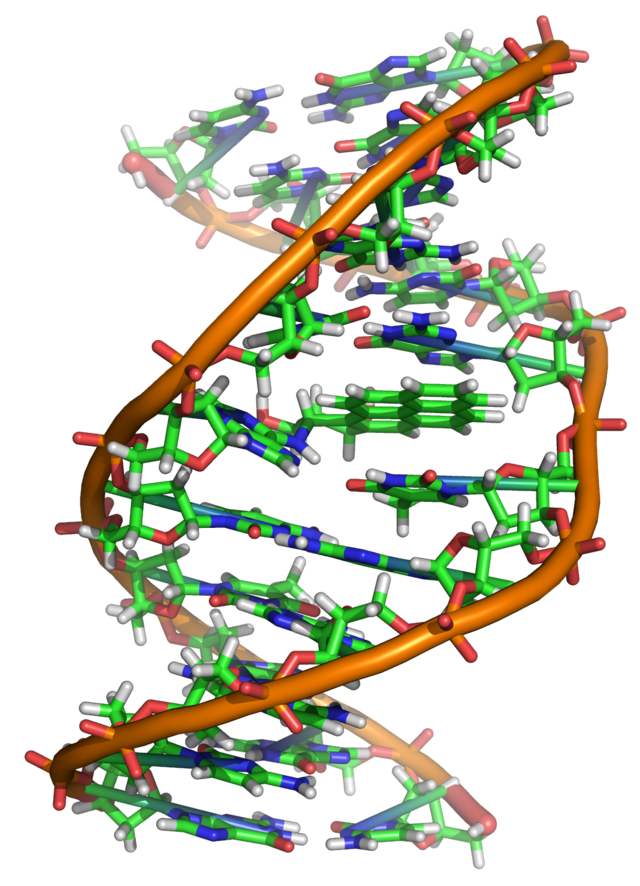
It’s the time of year for New Year’s resolutions and improving oneself. As a scientist, there are always about a million things to do to become a better researcher, but this year my resolution, and the one I hope all our readers adopt, is to become a better science communicator. Whether this means tweeting better links or publishing more frequently, the role of communication in science can’t be overstated. You don’t have to be a researcher to engage in scientific communication either, and it can be as simple as mentioning something you read or heard to a friend or family member. Continue reading “New Year, New Understanding of DNA”
Seven crucial academic skills parenting teaches you!
Parenting and academia are not mutually exclusive states. Many academics are parents, we take on different caring responsibilities at different stages in our careers and take on more or less of the parenting responsibilities depending on our family situation. However, parenting is often seen as detracting from our ability to succeed in academia in the zero sum game of work-life balance.
Yes parents* can be under significant time pressures and may have their mobility restricted, but the parenting skills we acquire through on-the-job training, constant practice, trial and error, research and pure luck can also help with the academic day job. It’s time to point out those skills that parenting gives you that don’t necessarily make it onto your cv but which probably should:
- Time management.
This is probably the most valuable skill you can have as an academic and strangely, the time constraints that parenting puts on you help you to be more effective when you’re in the office, lecture theatre or conference. Every second is precious and you learn to do those tasks that used to take you an hour in 18 minutes and those tasks that you used to schedule for “when I have a free day” to that time in between the departmental meeting and the next lecture.
Credit: Sean MacEntee
- Patience & the long view
Having kids has improved my patience from fairly non-existent to the ability to withstand constant nagging for at least 15 mins before cracking. Patience is an important skill in academia, where the wheels of bureaucracy turn more slowly than a 5 year old getting ready for school. Parenting teaches you to consider the long view, you understand that everything is a phase. While you have to go with the latest penchant for “Frozen” merchandise you also keep your eye on what life lessons a snowman who longs for the summer can teach your kids.
Credit: Ryan Wick
- Listening & communication
I’ve learned a lot about my own communication and listening from trying to converse with two-year olds. Being told what to do as an academic or as a two-year old doesn’t work, its all about persuasion and compromise. Listening to what your colleagues want and need, acknowledging it and trying to find win-win situations has a glimmer of hope of working. Be prepared for complete melt-downs at any point as your target audience is likely to be distracted by many other demands, shiny lights and chocolate in the tea room.
Credit: GollyGForce
- Communicating to different audiences – new networks & outreach
As a parent you are suddenly presented with new networks and opportunities for outreach: at the school gate, being invited to talk to the local primary school and sitting on the parents committee. This interaction with “the real world” helps with perspective, writing press releases for your most recent discovery and how to explain the importance of the latest p-value. Talking to your kids about your work can help to reaffirm your values – why do you do what you do?
- Routine
Most people with a small baby can relate to the importance of routine, if you can get it. Routines are super-important for children and academics. The complexity of the competing demands on our time means that those reliable tea times, weekly meetings and annual conferences are much more likely to be attended if they’re on the same time every day/week/month/year.
- Perfection is not an option & knowing when good enough is good enough.
I accepted very early on that I would never be the perfect parent. I read one of those pseudoscience parenting blogs that told me getting it right 30% of the time was probably good enough. At the time when I was driving myself into an early grave trying to be perfect 30% struck me as much more achievable. Knowing when good enough is good enough is a skill that I try to bring into my academic life. Often I help myself “Let it Go” by mentally evaluating the alternatives to a reasonable but imperfect job done: a) a child that has sat in some bubbly water with minimal scrubbing (the reasonable but imperfect outcome) vs. a shiny clean but grumpy toddler & stressed out parent (the “perfect” but ultimately terrible outcome) or a smelly little beast (sometimes necessary but poor outcome that we try not to let out in public/publish).
- Relating to students
As we get older and less like our undergraduate students, they get younger and more like our kids… Skills we gain as a parent, for example by helping kids to look on the bright side, building up their confidence and teaching them that sometimes life’s just like that, all helps in helping, guiding and mentoring our students.
Kids are infuriating, stressful, sources of worry and time sinks, but they are also wonderful, make you see the your life in new ways and give you perspective on the world. Replace “kids” with “academic jobs” in the previous sentence and that’s basically how I see it.
* I include here male and female parents, there are also many carers of family & friends who while not directly parenting are also under significant constraints. Some of these points may apply more generally to carers but they will have other specific issues to deal with – that’s another blog post…
Authors: Yvonne Buckley, BUCKLEYY[at]tcd.ie & Jane Stout, STOUTJ@tcd.ie
One body one problem
You may have heard on the academic grapevine that I will soon be leaving Trinity College Dublin. As with all moves I’m both sad to be leaving, but excited to take on new challenges. I’ll be around until the summer, but now this is common knowledge I wanted to explain why I’m moving on. And also to make something else really clear – I’m not leaving because I dislike working here! The School of Natural Sciences (and particularly Zoology where I’m based) has been a fantastic place to work for the last three years. The staff are friendly and supportive, the students are top notch, and the working environment here is energetic and collegiate. I’ve met some amazing people and I hope to continue working with them. I’ve also learned more than I thought possible in just three years.
Then why am I leaving? Mostly it boils down to the “one body problem“. We’re all familiar with the “two body problem”, whereby people in a relationship are forced to find ways to make their relationship and careers work at the same time. Sometimes this involves partners trying to get jobs in the same place, although it could be detrimental to their careers; other times people live apart so they can have more choices over which job to take. Either way it’s a crappy problem and I feel terrible for people in that situation. We talk less about the “one body problem” which also disproportionately affects women and minority academics, particular LGBT academics. I also believe it may be an important reason why these groups leave academia so I think it deserves more attention when we’re thinking about equality.
The “one body problem” refers to the difficulties single academics face when moving around for jobs. In its own way this can be just as bad as the “two body problem” (it’s often quite frustrating when people tell me how lucky I am to be single and free to move about). Arriving in a new place as a single person is daunting and, without the support network of a partner or friends, it is also extremely isolating. Making friends in a new place takes time, and the heavy workloads of academic jobs leave little time for friend making attempts. Added to this, academics are very transient so it’s not unusual to make a new friend, and for that friend to leave just a few months later (in Dublin even the non-academic community is fairly transient). This is particularly hard for international postdocs who don’t have family or friends living nearby to escape to at the weekends. The other issue with the “one body problem” is that eventually most single people would like to meet someone, even if they’re currently happy living an independent life. In some places this is next to impossible, for example, tiny college campuses in the middle of nowhere, and gets harder as people get older. Again this disproportionately affects women and minorities.
I’ve found this problem has become worse for me in recent years. I think this is partly because of my change in job status. As a PhD student and a postdoc I had far more free time to try and make friends when I moved. There were also lots of social events organised for students/postdocs where you could meet each other, and also form a bit of a community. This sort of thing is less common once you’re a professor. Also I’m now the one staying put as the postdocs and PhD students I’ve befriended move on to other places. It also reflects the fact that most people my age are married with kids, particularly the younger faculty here. We get on really well at work, but at 4pm everyone goes home. Eventually I realised that this situation was causing me a considerable amount of stress and unhappiness which was only going to increase as the friends I’ve made in the last three years prepare to finish their postdocs or PhDs and move on. So I’m leaving Dublin because I don’t have a stable support network here and in the long term that is not a good thing for me (or anyone).
If you have new single people joining your department I hope you’ll try and help them to settle in and don’t just assume that being single is the easy option for academics! Note that I’m not saying the “two body problem” is easier! Let’s just recognise that the academic lifestyle is hard for everyone and try to consider how to make things more equal for all women and minority groups, not just those with two body issues, and/or children.
Author: Natalie Cooper, @nhcooper123, ncooper[at]tcd.ie
Photo credit: “TheClashLondonCallingalbumcover” by Source. Licensed under Fair use via Wikipedia – http://en.wikipedia.org/wiki/File:TheClashLondonCallingalbumcover.jpg#mediaviewer/File:TheClashLondonCallingalbumcover.jpg