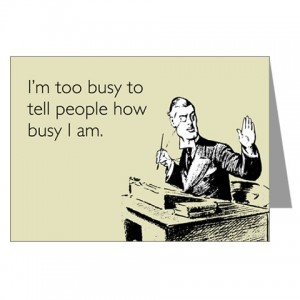
PhD students and the cult of busy


busyAcademics often remind me of the Four Yorkshire Men in the old sketch (not actually originally a Monty Python sketch, but famously performed by them in their live shows – comedy nerd out over, carry on), except rather than trying to outdo each with how deprived we were as kids, we’re always trying to outdo each other with tales of how busy we are. We do it so often that it becomes hard to draw the line between how much this reflects how busy we really are, and how much is just “bragging” to assert how important we are. Somehow, we associate importance/success with being constantly busy, and think that good scientists work stupidly long hours and rarely take a day off. This is so inbuilt into our working culture that we feel guilty when we only work 9-5 or have the occasional lazy afternoon!

Worryingly the cult of being busy starts with PhD students. It’s insane the number of times I hear PhD students turning down opportunities (both academic and recreational) because they are “too busy”. Of course there are always going to be periods where you are truly “too busy”. The last few days before you submit a paper, the weeks leading up to a conference, or when you’re in the final stages of writing up. But in general there is nothing in your PhD that is so important that you can’t delay it for a few days/weeks/months. Most times your supervisor won’t mind waiting a few extra days for a draft (they are also busy!), and you can always email journal editors for extensions when writing reviews or returning corrections.

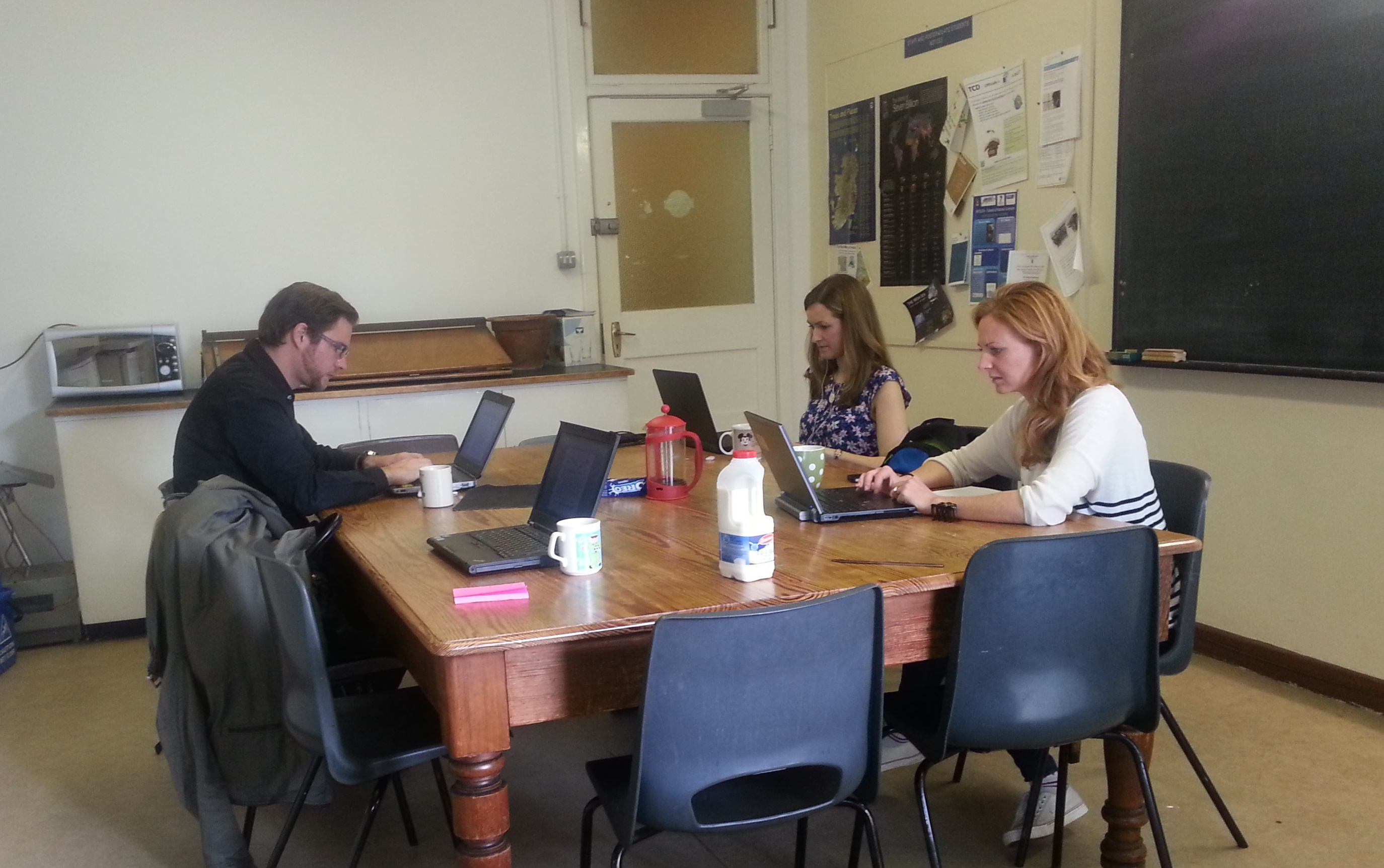
Full disclosure – I was the kind of PhD student that drives me crazy now. I refused to go to seminars unless they were completely related to what I was working on, I rarely read papers for lab meetings, and in my final year I stopped going to morning coffee, ate lunch at my desk and bit the head off anyone who came to my office to chat to my labmates (to be fair this got totally out of control when we got an espresso machine in the office and almost every postdoc in the building came by at least once a day! I’m blaming you Ezard! :P). I regret my tunnel vision now. There were so many things I could have taken time out to learn – things that would have saved me lots of time during my PhD and later in my career. This year I finally taught myself LaTeX for example, which would have saved me months of blood, sweat and tears formatting my thesis. I also wish I’d taken more time to learn to program properly. I’m now working hard to improve my coding, but see that if I’d taken a few months to do this in my PhD, I’d have saved myself a lot of heartache.

I guess my message to PhD students is to try and be less busy, and make more of an effort to enjoy the PhD experience! Easier said than done I know! I am sympathetic – I remember how it felt as a student. I remember feeling terribly inadequate compared to the high achieving PhD students and postdocs around me. I remember the crushing sense of panic and stress as my hand-in date approached and I still hadn’t got past my first chapter. I remember thinking that every hour doing something unrelated to my PhD was an hour wasted. But what I should have known, and what I’ll remind PhD students now, is that your PhD is about so much more than your thesis. Yes, you are judged on your thesis, and you will have to defend it. But you should also be training yourself to become part of the scientific community. Whether you stay in academia or not, it’s pretty unlikely that you’ll ever work on the exact topic of your PhD again. So you’ll need an awareness of other things that are happening in the world of science! You’ll also need to develop other skills, like presentation skills, teaching, and outreach. You can’t do that if you only focus on your PhD topic and nothing else.

But how can we be less busy (and hence less stressed)? This is something I’m constantly trying to deal with myself (if you think you’re busy as a PhD student, don’t ask a Faculty member how busy they are!). A few things I’ve found useful are as follows:

1. Learn to stop when something is “good enough”
Many of the traits that make us good academics, like attention to detail and the desire to do our best at things, can also lead to terribly stressful perfectionism. Instead try to establish when something is “good enough” rather than “perfect”. This is something I’m trying to improve at myself, and I’ll admit that it’s difficult. However, as a PhD student your supervisor should be able to help. Sometimes you can leave stuff like properly formatting references until you’re ready to submit a paper. If you’re really struggling with one section, maybe send the rest to your supervisor for comments, rather than waiting until it’s all perfect (but ask them first).

I find deadlines help me with this – for example, I have a habit of constantly fiddling with lectures so if I have two weeks to make one, it will take me two weeks. However as time goes on, the amount of improvement approaches an asymptote, so two weeks of effort doesn’t create a lecture much better than one that takes me a week. Therefore I give myself strict amounts of time I’m allowed to work on each lecture. After that time passes it’s done. It’s not perfect, but I doubt the students would notice the difference. The same goes for conference presentations and paper drafts.

2. Use “waiting time” efficiently.
PhD students often forget in their rush to finish something and hand it to their supervisor, that their supervisor will take time to return it with comments. If you know this is going to happen you can use that waiting time more wisely. It’s often a good time to format references, add details to manuscript central if you’re submitting a paper, fiddle around with your thesis template etc. Also talk to your supervisor about when they have time to give you comments. There’s no sense in rushing to hand in a draft chapter the day before your supervisor goes on holiday for two weeks leaving you twiddling your thumbs.

3. Schedule time for non-essential reading or for learning skills
As a PhD student I stopped reading widely near the end of my PhD. However, at postdoc interviews I often got asked about what papers I’d read recently that I’d enjoyed. These questions are designed to see how broad your knowledge is, so citing the technical paper you just read on your PhD subject is not going to impress. Additionally, if you want to stay in science (academia or otherwise), you probably should have a basic knowledge of the current controversies in the field. The only way to do this is by reading. However, it’s hard to read non-essential stuff. The easiest way to ensure you do it is by scheduling a bit of time each week (maybe Friday afternoon or Monday morning) to do it. If you choose a time you usually get very little work done it won’t eat into your productivity. I often use this kind of scheduling to learn programming skills or to play with a new R package.

4. Say yes to opportunities!
Of course there’s a limit to how much you can say yes to. But remember that your time as a PhD student is probably one of the most flexible times of your life, especially if you don’t have kids yet. Your schedule is mostly yours to make. So if you can’t get anything to work, spend the day in a local museum and catch up one evening or at the weekend. If you live in a rainy place (cough cough Ireland) and the sun is out, take the afternoon off and go for a bike ride or a walk – you can work a little longer tomorrow when the sun disappears! If you get offered skills training take it, particularly if it’s free and doesn’t require traveling too far. If your friend wants a hand on tropical field work for a couple of weeks, and you have the money, go with them! It’s a great chance to see an exciting country in a whole new light. Go to seminars and conferences. Talk to your colleagues at coffee time. Take a proper lunch break. It’s amazing how much you can get done in short bursts when you need to, especially if you’ve scheduled in proper breaks.

5. But learn to say no to time sucks…
Not everything people ask you to do is going to be useful, and/or fun. If in doubt, speak to your supervisor before saying yes to things (you can then also use the old “my supervisor is an ogre and won’t let me help you, sorry” excuse). For example, organising an event like a conference or an outreach event, is a great thing to have on your CV. But once you have one of these on your CV the gains of organising a second one are low. These things often take up ridiculous amounts of time and energy. The same goes for teaching. It’s great to get teaching experience, but try and get quality experience with different kinds of teaching rather than saying yes to everything. Be strategic in what you spend your time on, based on filling gaps in your CV, and preferably on what you want to do after your PhD.

6. Talk to someone if you need help.
Finally, if you’re really struggling with feeling busy and overwhelmed, talk to someone! Sometimes in academia we have the habit of not talking about problems. This leads us to believe that everyone else is coping, and we’re the only ones struggling. The truth is EVERYONE struggles sometimes. Talk to your friends/PhD colleagues about how you feel – they’ll soon make you feel less alone. Talk to your supervisor, or another faculty member, about ways of coping with stress. And remember most places have a student counseling service if things are too hard to discuss.

Now go forth, be less busy, more happy and more productive as a result!

DISCLAIMER – Your PhD is not all about your thesis. BUT finishing your thesis on time is the most important thing at the end of the day. This post is not about encouraging slacking off, it’s about encouraging efficient working practices. Research has shown that people working 35 hour weeks get as much done as those working 60 hours (long-term, short-term there are gains in working long hours). So use your time wisely, work hard when you have the energy and motivation to do it, and speak to your supervisor if you’re worried about your progress. They are here to help!

Author: Natalie Cooper, @nhcooper123, nhcooper[at]tcd.ie
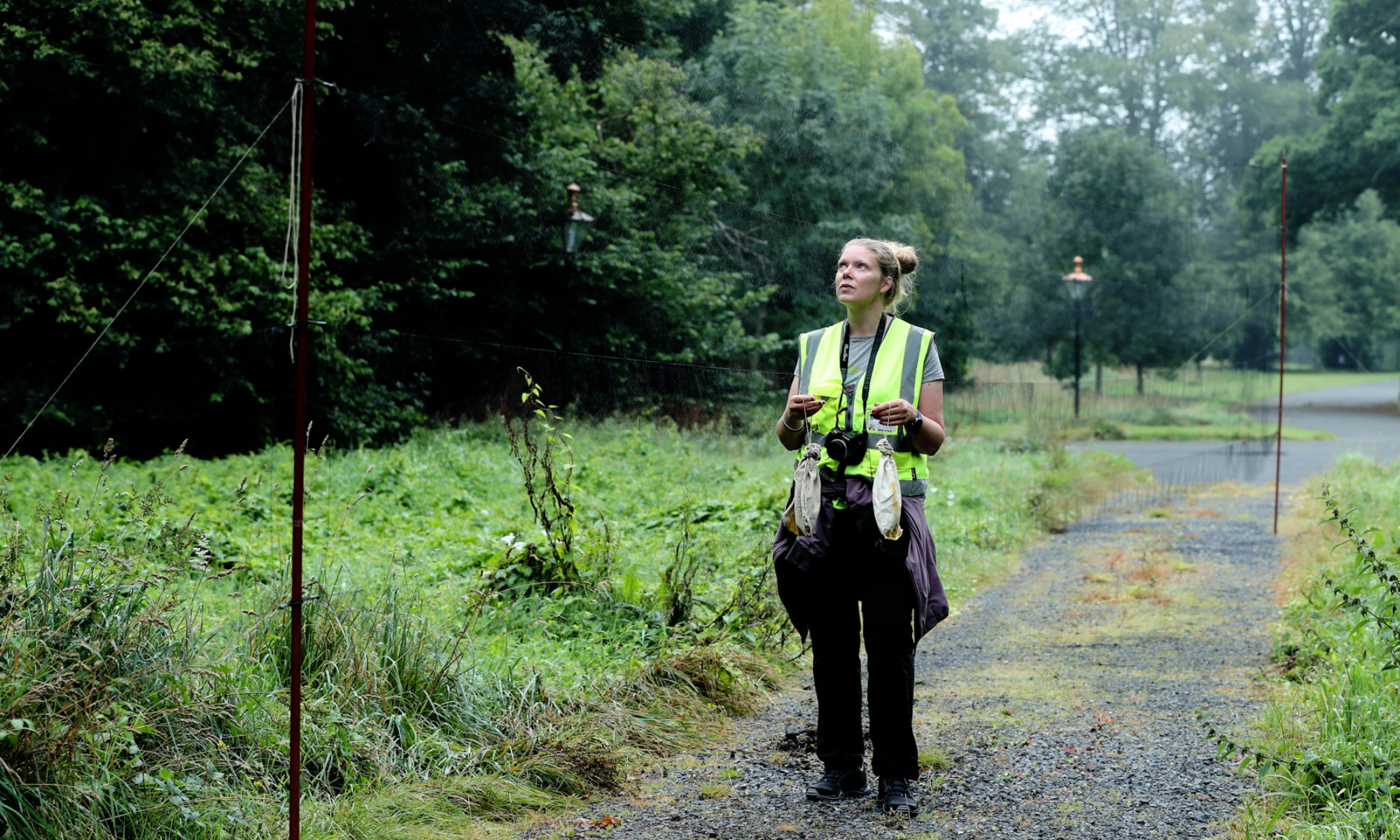
Night Life! Friday 26th Sept

Night Life no writing

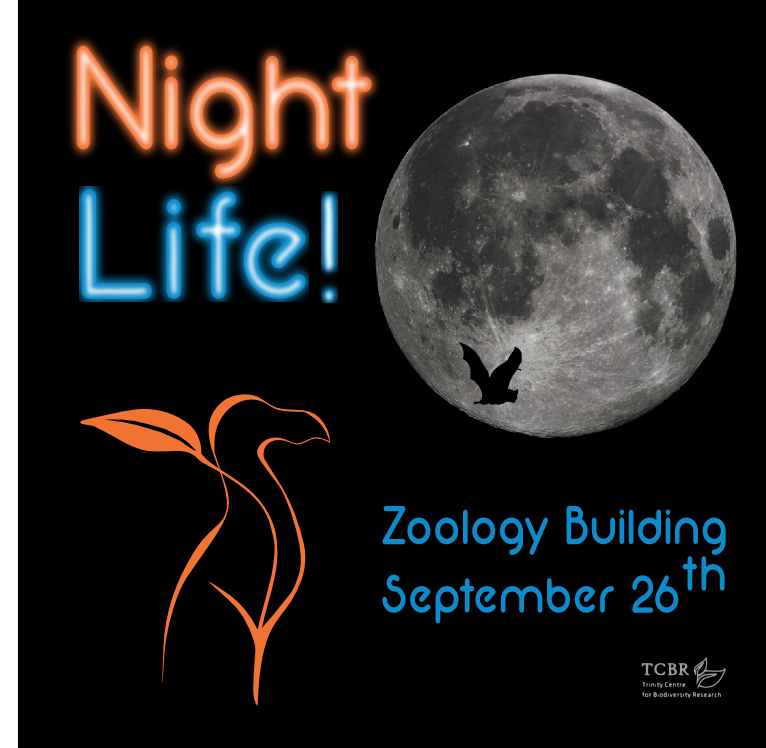
This Friday, members of EcoEvo@TCD, as well as others from the Botany and Zoology departments and Trinity Centre for Biodiversity Research will present Night Life! in the Zoology building at Trinity College Dublin. The event is FREE to attend and we will be open from 6pm-10pm with the last entry at 9.30pm.

Night Life! is an opportunity to meet researchers and to find out the kinds of things we do. Prof. Yvonne Buckley will give you a taste of our research highlights, Kevin Healy will wow you with his research on snake venom (yes there will be snakes!), Sive Finlay will perplex you with the mysteries of tenrec evolution (if you don’t know what they are, come along and find out, they’re really cute!), Sean Kelly will explain how he discovers new bird species in Indonesia, Deirdre McClean will reveal the fascinating social lives of microbes, Thomas Guillerme will dazzle you with the lasers on his 3D scanner and the jaws of a shark, Claire Shea will amaze you by explaining why babies kick in the womb, Adam Kane will intrigue you with models of T.rex and maybe some vultures, and other students will be available to answer your burning questions about biology, evolution and ecology. So if you’re at a loose end on Friday night, come along and say hi!

Night Life! forms just one part of Discover Research Dublin, an annual event funded by the European Commission as part of European Researchers’ Night. The event is hosted by Trinity College Dublin, in partnership with the Royal College of Surgeons in Ireland. As well as Night Life! the evening will feature over 50 fun, interactive and free events and activities which will give you direct contact with researchers and allow for discovery, questions and participation. The event aims to challenge perceptions about researchers and show the creativity and innovation that exists in research across all disciplines. Activities are grouped under four broad themes – Body Parts, Creativity in Research, Meet the Researchers and Living Thought/Thinking Life.
We encourage you to visit, explore, discover and enjoy!

Author: Natalie Cooper, @nhcooper123
Image: Kevin Healy, @healyke

Creationism in Science Fiction: Artistic freedom or anti-science?

Black_Hole_Outflows_From_Centaurus

In the late 90s and early 2000s science fiction fans such as myself had a bit of a hard time. As happy as I was when the last few years brought, amongst others, the amazingly crafted science fiction spectacles Battlestar Galactica (2004) and the long anticipated Alien prequel Prometheus (2012), the more disappointed I became when I realised that both events based their storylines heavily on creationism.

Now one might argue that these are works of art and therefore subject to artistic freedom, and generally I do agree. But then again, that wouldn’t be much of a blog post. So let me describe why this is not only such a disappointment, but also cause for a bit of a tummy ache.

First of all, science fiction is not an art form as such but rather a movement within different artistic disciplines. Lots of disciplines use elements from science fiction. It appears in classic literature such as the works of Jules Verne, and the myriad of other authors following his footsteps, and on the silver screen with the most prominent works being Star Trek and Star Wars. More recently (and not surprisingly) science fiction is prominent in computer games and even in music, especially within electronic music with the best example surely being the robot outfits of French house legends, Daft Punk.

Within all these different art forms there must be a common ground, something that can give such different expressions as sound, word or interaction a common name. So what unites all these art forms under the science fiction umbrella? The most straightforward term that we might could come up with is ‘future’, but that would be too simple. Remember that Star Wars took place ‘A long time ago, in a galaxy far away’, but no one would refute that it is one of the defining works of science fiction. I think that the most important element in science fiction is exploration: take the now, look at our social, scientific and technological achievements and make a step forward. Imagine what could happen, imagine a Utopia, a Dystopia, or a world not so different from our own. It can take place on different worlds or on our own home planet. The defining element is that it is a fictional continuation of our current knowledge, exploring whatever implications the creator of the work wants to explore.

And there lies my problem with Creationism. In order to explore the future consequences of our current state-of-art, we must get the state-of-art right. Among the science fiction fans I know it is usually accepted that the general premise in science fiction is theoretically possible, given the knowledge at the time. Of course not everything has to be realistic: the Force in Star Wars adds a mystical element, and that is completely acceptable since it is defined as mystical within the original movies. However, when Prometheus takes an intelligent design approach, it sets an anti-science premise, and builds a future from it, giving the impression that intelligent design is a scientifically valid theory. Battlestar Galactica goes even one step further, bringing God directly into play as the creator. While one could consider this as an example of the previously mentioned mystical element, albeit in a somewhat convoluted way, the story of the show managed to completely mix up mysticism and hard science in a way that is nearly impossible to disentangle, especially for the viewers who do not have a background in science. (It is beyond this blog to summarise the story of a four seasons show, so for the readers interested in more detail I recommend the following essay by Brad Templeton.)

Using creationism or intelligent design as a creator of works of science fiction has two consequences: it disappoints those fans, such as myself, that have a background in science and it gives those fans who do not have a scientific background a false impression of realism associated with creationism, spreading anti-science further.

Of course this is a personal opinion, but I stand to it when I say that creating a work of science fiction should always take the science on which it is based seriously, whether that be promoting a technological future or warning about its perils.

Author: Jesko Zimmerman, zimmerjr[at]tcd.ie

Image Source: Wikicommons

Learning the art of conferencing

Networking

The start of the new academic year marks the end of my second conference season. I attended two conferences; Evolution 2014 in Raleigh, North Carolina and the British Ecological Society Macroecology meeting at the University of Nottingham. They were at the opposite ends of the spectrum in terms of size and specificity but they were both interesting, useful and, most surprisingly for me, enjoyable.

The difference is that I knew what to expect. Last summer was my first taste of conferences along with the intellectual and social stamina required to last through a day of talks, coffee breaks, poster sessions and post-conference socialising. I was very lucky that I went to each event as part of a group, so there was always a familiar face to find in a crowd and it made networking easier but I still found the whole experience challenging.

This time around was different; the familiarity made everything easier. For a start, I finally figured out how to plan a sensible schedule which didn’t involve running from one room to another between talks. Most importantly, I’m learning how to “play the game”. I’m slowly figuring out how to give an elevator pitch about my research without making the recipient’s eyes glaze-over and how to talk to other people about their research without sounding like a complete idiot. I’m still a long way off from being a proper conference pro but I’m getting there.

Giving a talk instead of a poster made a huge difference. Last year I brought the same poster to two different conferences. Through the course of each poster session, I spoke to a handful of people, some of whom seemed at least partly interested in my research but mostly they were being nice to the student with no one else at her poster. The experience definitely made me into a more pro-active browser at other poster sessions. People usually appreciate some interaction and it’s always more interesting to talk to someone about their research, even if it’s completely outside my area, instead of just admiring their poster design skills.

This year I gave a short talk at both the conferences I attended. It was nerve-wracking but definitely much more beneficial for my research and also my conference experience. I was lucky to have some useful preparation: we’ve often covered presentation skills in NERD club and I benefited from great constructive criticism during practice talks, especially from Thomas and Natalie who could probably have delivered my talk word for word by the time of the conference! It was worth the effort. My presentation was not ground-breaking in terms of the science content or delivery but I was pleased with how my talks went at both conferences. It was also very beneficial to get the feedback, comments and suggestions from the people in the audience who spoke to me afterwards. You get a lot more feedback after telling an audience your research “story” for 10 minutes rather than hoping to attract passers-by to a poster. Furthermore, at a small conference like the macroecology BES group, giving a talk helped to identify me as the “tenrec girl” so I could speed past the normal elevator pitch opening which marks most initial conference conversations.

Some people take to conferences easily; others have to work a bit more. If you’re part of the latter group then I can assure you that everything becomes easier and more enjoyable with a bit of familiarity, practice and experience. I still have a lot to learn but I’m getting there. I’ve realised that many people, particularly the more junior researchers, also find it tricky to master the art of conferencing. So if you’re feeling awkward standing around the coffee counter or sitting in a seminar on your own, chances are that the person next to you is in the same boat and you will both be happier if someone takes the first plunge into conversation. You will add another name to your list of friendly faces in the crowd or maybe meet a new collaborator. In any case, you’ve got nothing to lose so give it a go!

Author: Sive Finlay, sfinlay[at]tcd.ie, @SiveFinlay

Image Source

Gender balanced conferences – we all need to try harder!

gender equal opportunity or representation

Recently a conference on Phylogenetic Comparative Methods was advertised online, and quickly the Twitter community noted that all six of the plenary talks were being given by men. Normally my response to this kind of thing would be some grumpy tweeting and then I’d let it go. However, this time was different; I know one of the organisers, several of the plenary speakers are my collaborators and this is the field I’ve dedicated the last eight years of my career to. Therefore I didn’t think I could let this pass by unchallenged. Continue reading “Gender balanced conferences – we all need to try harder!”

We’re back!

Back-to-School

It’s that time of year again, the quiet before the storm of Fresher’s week and the start of a new academic year.

After our short break, EcoEvo@TCD is back and raring to go. You can expect lots more posts about our research, seminar series, outreach activitiesconferences and fieldwork as well as tips and tricks for surviving in academia.

We’ve already kicked off the year with our second annual NERD club AGM. It was a great opportunity to discuss what we covered throughout the year and to make plans for the months ahead. (For the uninitiated, NERD club is our networks in ecology/evolution research discussion group but feel free to think of it in the true sense of the word too).

Here’s our NERD club prize winners for 2013/14

Best session: Paul for his talk on carnivory in plants

Best blog: Adam for “Flatland” and the “Heat and Light of Science Communication

Best pun (aka the McMahon and Kane memorial punning prize): Adam and Thomas for “Gould Mine”

Contributor of the year: Kevin

Best PI called Andrew: What is Andrew Jackson? (No-one knows!)

We’ve had some excellent sessions about transferable skills, how to navigate the perils of academia and great discussions and collaborations on current research projects. We’ve got lots more interesting topics planned for the year ahead which will definitely make an appearance on EcoEvo@TCD.

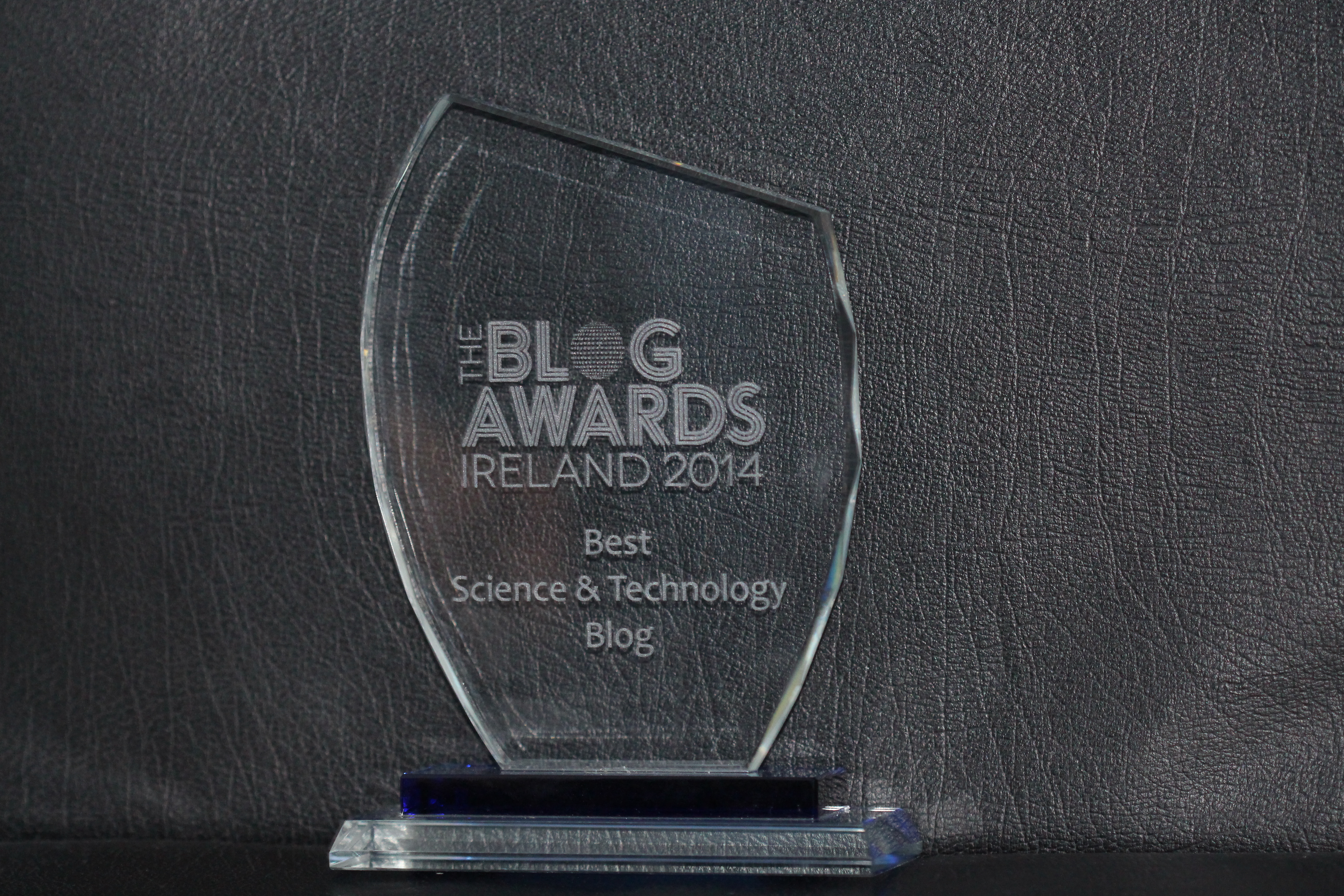
It’s also been a very successful year for our blog. We had a winner at the ABSW science writers awards and two semi-finalists in another international blog competition. We’re also on the short list for the best science and technology blog in the Irish blog awards.

So whether you’re packing away your fieldwork gear after another season, dreading the darker evenings or sharpening your pencils for another academic year, rest assured that you can look forward to some more ecology and evolution- related musings from the EcoEvo@TCD team.

Author: Sive Finlay, @SiveFinlay

Image source


We’re all going on a (science) summer holiday…

summer holiday


We’ve had another fantastic year at EcoEvo@TCD. We’ve published some high profile papers and brought back tales from our fieldwork experiences. We’ve learned how to navigate some of the perils of academia and thoroughly enjoyed hosting an excellent series of seminar speakers.

Now EcoEvo@TCD will be taking a short break over the summer so we won’t be updating the blog over July and August. We’re currently in the midst of another conference season, presenting our research at various international meetings and learning about the latest cool scientific research. Add that to some exciting travels and summer science projects and we’ll have plenty of stories to tell.

When we get back we’ll report on the highlights of conference season and bring you more ecology and evolution related news, views and advice.

We hope you have a wonderful summer. See you in September!

Author: Sive Finlay, sfinlay[at]tcd.ie, @SiveFinlay

Image Source: pixabay.com

Hard science?

Pure mathematics formulae

Are you a hard or soft scientist?

According to one 19th century science philosopher, the hierarchy of scientific disciplines is strictly segregated with physics and chemistry at the top, biology somewhere in the middle and social science towards the bottom (while astrology and homeopathy must occupy some nether-regions in the bowels of patently unscientific pursuit). The stereotypical view of hard scientists; scrawled equations, incomprehensibly complicated diagrams and lab coats which have definitely seen better days is in stark contrast to their soft scientist cousins; glorified stamp collectors who get into a tizzy over the finer details of the classification of the lesser-spotted something or other. There’s even a hard/soft distinction within biology; surely playing with genes, molecules and machines that go “ping” must be far more scientifically rigorous than conducting habitat surveys or behavioural experiments? I’m not suggesting that societal perception of scientific research is always so limited but the underlying biases, however subconscious, do remain.

The perceived differences between hard and soft seem to stem largely from the degree of mathematical theory underpinning your research. Physics involves maths; maths is hard therefore physics is a hard science. In contrast, traditional biology is merely comprised of learning the parts of the body and possibly frolicking in a few fields. There’s little or no maths involved so biology must be soft. Gross simplifications they may be but I think these views echo the underlying biases of many people, scientists included. They are, needless to say, rubbish.

For a start, maths is inescapable in all sciences. Elaborate equations filled with strange symbols are alive and well in all aspects of biology and social sciences. Ecologists are no more immune from the necessity of mastering mathematical concepts and techniques than their physicist brethren. Admittedly, the prominence of maths does vary according to research discipline; theoreticians are far more likely to be concerned with the finer details of some statistical method than the field biologist applying that method to study changes in squirrel populations. However, to claim that modern research in traditionally softer sciences is any less maths-reliant than the hard sciences is clearly misguided.

So if maths is inescapable does that mean that all science is hard? Well yes. To the extent that all, true science (i.e. hypothesis-driven, testable predictions with proper application of the scientific method) involves maths then yes all science is “hard”. But the application of mathematical techniques doesn’t necessarily deserve the exalted position it receives. Quantitative tests and mathematical models are all well and good but they’re virtually meaningless without real-world observations and predictions as their basis. Maths must be informed by the “softer” side of qualitative scientific observations.

Similarly, maths can be difficult, sometimes even impenetrable when it reaches the upper echelons of some complicated proof for a theory which you don’t understand in the first place. But I don’t think that maths deserves to be seen as any harder than other subjects. Leaving Cert students are now awarded bonus points for passing higher level maths. While the scheme has encouraged more students to stick with higher rather than ordinary level maths it also has the unfortunate effect of perpetuating the view that maths is harder than any other subject. Hopefully the new Project Maths syllabus will help to knock maths off its rarefied pedestal and make it more accessible to students (although the desired effect does not seem to have kicked in yet).

So break down the scientific class structure and don’t be intimidated by the special scientists with machines that go ping. Rather than nonsensical notions of hard vs. soft or hierarchies based on who uses the most complicated maths, it would be far more productive to concern ourselves with the distinction between good vs. bad science. The differences can sometimes be hard to spot but critical understanding of which scientific findings to trust is far more important than any outdated rivalries between the frizzy-haired physicists and glorified beetle collectors of bygone eras.

Author: Sive Finlay, sfinlay[at]tcd.ie, @SiveFinlay

Image credit: Wikimedia Commons

We have a winner!

trophy

We’re delighted that one of our regular EcoEvo@TCD writers, Sarah Hearne (@SarahVHearne) has won a prize from the Association for British Science Writers. Sarah won first place in the new Good Thinking student science blog category for her piece, Sea Serpents off the Port Bow! published in November last year. These prestigious awards recognise excellence in scientific journalism and writing from both students and professionals and it’s a great achievement to have been singled out among such stiff competition.

Congratulations Sarah!

Seminar series highlights: Phil Stevenson

hoenybee

As mentioned previously on the blog, Andrew Jackson and I started a new module this year called “Research Comprehension”. The module revolves around our Evolutionary Biology and Ecology seminar series and the continuous assessment for the module is in the form of blog posts discussing these seminars. We posted a selection of these earlier in the term, but now that the students have had their final degree marks we wanted to post the blogs with the best marks. This means there are more blog posts for some seminars than for others, though we’ve avoided reposting anything we’ve posted previously. We hope you enjoy reading them, and of course congratulations to all the students of the class of 2014! – Natalie

Here’s articles from Maura Judge and Chris Parsisson inspired by Professor Phil Stevenson‘s seminar, “Pollinator fidelity in coffee and citrus: is it all just sex and drugs?” Continue reading “Seminar series highlights: Phil Stevenson”